




Disclaimer: This article is for general informational purposes only and does not replace guidance from law enforcement or emergency services. If you believe you see an active AMBER Alert match or immediate danger, call 911.
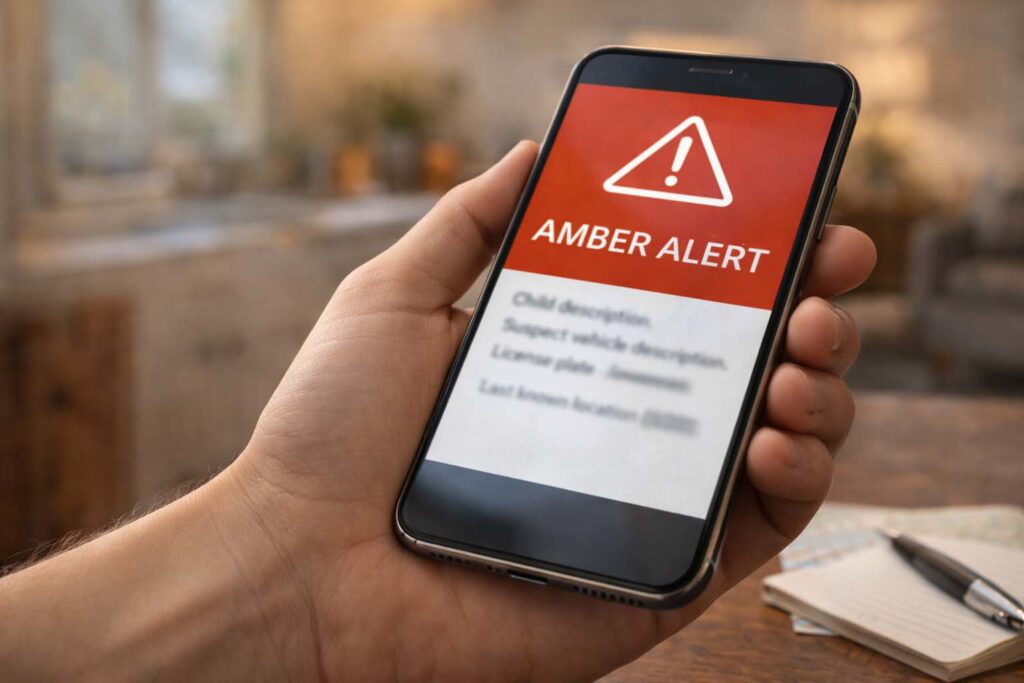
The first time most people notice an AMBER Alert, it is not during a calm moment. It is usually the sudden cell phone alert tone louder than a text, sharper than a typical notification that makes the heart jump.
A screen lights up with a public safety alert message, and there is a split-second choice: swipe it away or read it. If you’ve ever wondered what does an amber alert mean, you’re not alone and you’re also exactly the kind of “extra set of eyes” the system is designed to reach.
This guide explains the program purpose and definition in plain language, walks through the key identifiers to look for, clarifies where to report sightings, and lays out safety-first response steps that help without creating risk.
The goal is simple: help readers respond like a calm, useful witness because in the earliest moments of an abduction, good information from the public can support the child recovery effort.
What Does an AMBER Alert Mean? (and What It Is Not)
An AMBER Alert is a time-sensitive child abduction alert used when law enforcement believes a child has been abducted and is in danger.
The system exists to push accurate descriptions to the public quickly because speed and reach can matter. The National Center for Missing & Exploited Children explains that the goal is to “galvanize the community” to assist in the search and safe recovery, using channels like TV, radio, road signs, and phones.
Put simply: an AMBER Alert is an abducted child notification meant to prompt immediate public assistance not panic, not amateur detective work, and not social-media speculation.
Program purpose and definition (plain English)
At its best, an AMBER Alert is a structured broadcast of actionable facts that helps the public become additional “eyes and ears” for law enforcement. It is designed for rapid information sharing, typically including:
- Who is missing (basic child description details)
- Who may have taken the child (suspect description details)
- What vehicle may be involved (vehicle make and model, suspect vehicle description)
- Where and when it happened (last known location, time of abduction)
- Which way the suspect may be traveling (direction of travel)
This is why the public is involved: a single credible sighting can matter, especially if it includes details that confirm the correct vehicle or route.
AMBER Alert vs other alerts (avoid confusion)
Emergency notifications vs. news alerts
An AMBER Alert is an emergency channel alert, not a “trend,” not a local news push notification, and not the same thing as weather warnings.
Many people are more familiar with weather alerts from the National Weather Service (NWS), which are different in both purpose and criteria. An AMBER Alert is tied to a suspected abduction case; weather alerts are hazard-based and routine.
Missing child emergency vs. endangered child bulletin
A missing child emergency can mean many situations, including runaways or lost children. An AMBER Alert is narrower: it is a specific system for serious abduction cases. Some states and agencies also use terms like endangered child bulletin, which can sound similar to the public but may follow different internal rules.
The key is: if the message says AMBER Alert, it has already passed defined criteria for urgent public distribution.
Common misunderstandings (quick myth-busting)
- “It’s automatically nationwide.” It is not. The system often targets a region based on the available facts, which is why understanding alert geography matters.
- “It means the child is definitely nearby.” Not necessarily. It means the alerting authority believes the public in a certain area may help.
- “It’s just a social media rumor.” An AMBER Alert is an official law enforcement alert. Still, preventing misinformation is critical because old screenshots and copied text can spread faster than corrections.
How AMBER Alerts Actually Get Issued in the U.S.
Many people assume an AMBER Alert is “automatic,” like a fire alarm. In reality, it is a decision process with defined alert eligibility criteria, and it involves multiple organizations and systems.
Who runs and coordinates the system (Entities + trust)
AMBER Alert guidance and national coordination connect to the U.S. Department of Justice (DOJ), specifically through the Office of Justice Programs (OJP) and the Office of Juvenile Justice and Delinquency Prevention (OJJDP).
Operationally, the system also involves:
- The National AMBER Alert Network (coordination across plans/jurisdictions)
- The National Center for Missing & Exploited Children (NCMEC) (support, resources, and public-facing guidance)
- A state AMBER Alert coordinator (varies by state)
- A state emergency management agency (often involved in alert infrastructure and distribution pathways)
The point is not bureaucracy. The point is consistency: clearly defined criteria help reduce confusion, increase credibility, and speed distribution when minutes matter.
The alert eligibility criteria (why not every case triggers one)
Eligibility requirements
While details vary by state plan, DOJ guidance emphasizes clearly defined activation criteria. In practice, eligibility requirements generally include:
- Law enforcement believes an abduction occurred (often begins as a suspected kidnapping report)
- Law enforcement believes the child is in danger
- There is enough descriptive information to help the public identify the child/suspect/vehicle
- The case is recent enough that public distribution can meaningfully help
This is also why many custody disputes or vague “missing” reports do not trigger the system: AMBER Alerts are reserved for the highest-risk scenarios.
Activation thresholds
Here is where the system tries to balance urgency with credibility. Plans often require a credible threat assessment and an imminent danger standard meaning law enforcement believes the child is at risk of serious harm. A DOJ criteria document explicitly recommends requiring risk of serious bodily injury or death and sufficient descriptive information.
These activation thresholds also help reduce alert fatigue. If alerts were issued for every missing-person situation, the public would stop paying attention.
Timeline from report to alert (step-by-step)
Suspected kidnapping report → missing person report
The timeline starts with a call often to a local agency followed by verification. A local police dispatch center may receive the initial report, which becomes a missing person report once basic details are recorded and confirmed.
At this stage, officers and investigators try to answer urgent questions quickly:
- Is there evidence of an abduction?
- Is the child truly missing, or is there a benign explanation?
- Is there enough information to help the public identify a suspect or vehicle?
Child abduction investigation + data sharing
If the case meets the criteria, the child abduction investigation expands rapidly. Information may be entered into the National Crime Information Center (NCIC) so other agencies can see it in real time. If circumstances require broader support, the FBI (Federal Bureau of Investigation) may assist.
This is also where the public should understand a crucial reality: information changes fast. Early descriptions can be incomplete, which is why later updates and corrections matter.
Statewide alert activation vs. multi-state alert expansion
If there is reason to believe the abductor may travel, the alert may broaden beyond the initial area. Statewide alert activation can occur when the suspect could be anywhere in the state; multi-state alert expansion can occur when direction of travel suggests border crossings or major travel corridors.
How You’ll Receive an AMBER Alert (Channels You Should Recognize)
AMBER Alerts reach people through multiple delivery channels so that the message is hard to miss.
Wireless Emergency Alerts (WEA) on phones
Phones typically receive AMBER Alerts through wireless emergency alerts (WEA), also known as Wireless Emergency Alerts (WEA). The FCC describes WEA as geographically targeted, text-like messages delivered to compatible mobile devices.
WEA delivery involves:
- cellular carriers (mobile network operators)
- Geographic targeting so the message is relevant to a region (a geofenced alert area)
Emergency Alert System (EAS) on TV/radio
AMBER Alerts can also be broadcast through the emergency alert system (EAS), formally the Emergency Alert System (EAS), which interrupts or overlays TV and radio programming. FEMA describes IPAWS as sending authenticated alert information through WEA and EAS among other pathways.
This is where the role of broadcasters and carriers becomes visible: media broadcasters (TV/radio) help distribute the information widely.
Other public channels you may see while driving
Many people see AMBER Alerts while driving on roadway signage. You may encounter a digital highway signs alert on digital highway message signs. Highways matter because they are efficient escape routes; public visibility on major routes can support intercepts and tips.
Mobile settings and opt-out rules (practical)
Many phones allow users to control which alert categories they receive. Mobile settings and opt-out rules vary by device and carrier, and local policy may affect default settings.
The practical recommendation, from a public-safety standpoint, is to keep emergency alerts enabled so that critical messages are not missed.
How to Read an AMBER Alert Like a Checklist
The most helpful civilians do not “do more.” They do the right few things fast, accurately, and safely.
Reading the alert details (the 20-second scan)
Key identifiers to look for
A useful mental scan is: child + suspect + vehicle + where/when. These are the key identifiers to look for because they are the fastest way to validate a sighting.
Child description details
The alert may include the child’s approximate age, height, hair, clothing, and any distinguishing features. Recognizing clothing descriptions matters because clothing is often the most visible cue in public settings.
Suspect description details
If the alert provides it, note the suspect’s estimated age, hair, clothing, tattoos, or other distinguishing features. This can help in crowded places where vehicles are less visible.
Vehicle make and model + suspect vehicle description
Vehicle details are often the most actionable. The alert may specify vehicle make and model, color, damage, stickers, missing hubcaps, or other cues these are recognizing vehicle distinguishing marks in real life.
Most alerts also include a license plate if known. This is where a license plate number search mindset is useful: people do not need to memorize the whole number; capturing partial digits plus state can still help, especially when paired with the vehicle description.
Understanding alert geography (don’t assume it’s “everywhere”)
Alerting authorities choose an area where the public is most likely to help. That may include a geofenced alert area around the incident, a travel corridor, or a broader region when the destination is unknown. The alert being received does not guarantee proximity; it indicates relevance.
Confirming the information (without delaying action)
Some readers want to verify before acting. That is good if it does not create delay. A practical approach to confirming the information is to check official sources quickly local agencies and recognized public-safety channels then proceed with safe observation and accurate reporting. This is part of checking local updates without relying on rumor.
How You Should Respond (Safety-First, Doable Steps)
People often assume “helping” means chasing a vehicle or confronting someone. In reality, the most helpful response is almost always quiet, safe, and information-focused.
Staying calm and alert (your mindset matters)
Staying calm and alert is not just an emotional preference; it improves memory. Calm witnesses observe better, remember more accurately, and report with fewer distortions.
Safe observation practices (do this first)
What to do if you are driving
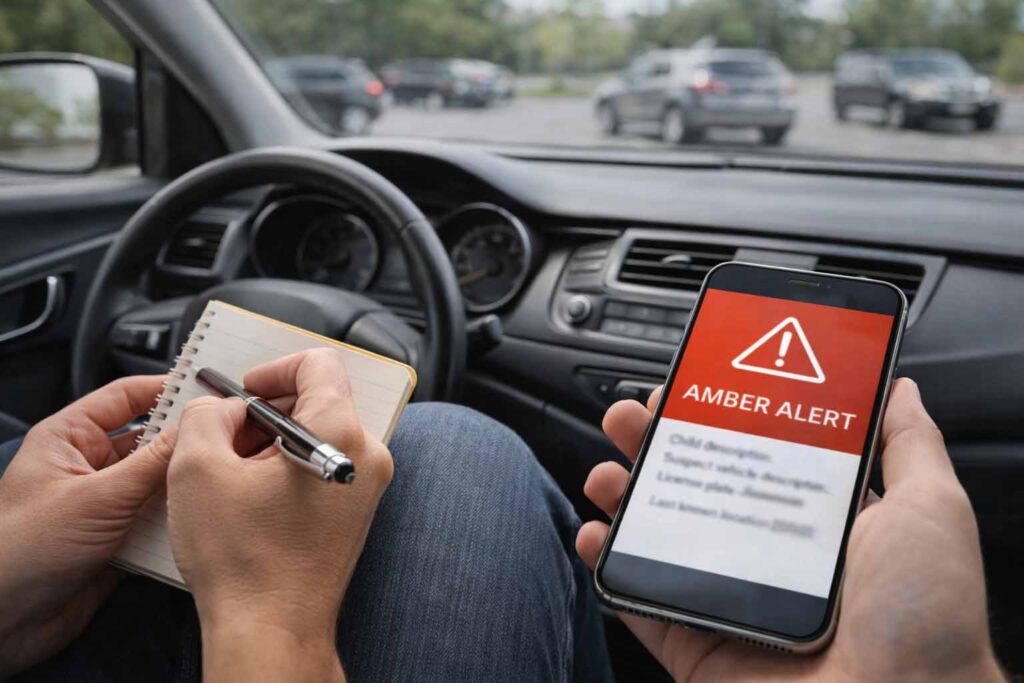
Drivers should treat safety as the first obligation. Do not text or photograph while moving. Pull over safely before documenting time and place. The guiding rule is: spot, don’t chase. Safe reporting beats risky pursuit.
What to do if you are at home or in public
In public settings, people can scan relevant environments parking lots, gas stations, transit hubs without harassing strangers. This is safe observation practices and also a key part of community vigilance without panic.
Avoiding direct confrontation (a key safety rule)
Avoiding direct confrontation protects everyone. A suspect may be armed or volatile; confrontation can escalate danger for the child, bystanders, or the would-be helper.
Documenting time and place (your tip becomes actionable)
Taking note of plate numbers
The most helpful tips are specific. Taking note of plate numbers can be as simple as writing down:
- plate state
- partial digits/letters
- vehicle color and body type
- distinctive damage or decals
This turns a vague “maybe I saw it” into a usable lead.
Witness statement reporting (what details matter most)
Good witness statement reporting sticks to observable facts:
- where it was seen
- when it was seen
- which direction it was moving
- what matched the alert
- what did not match (if relevant)
Where to report sightings (fast and correct)
911 reporting guidance
If a person believes they are seeing the vehicle or child in real time or there is immediate danger follow 911 reporting guidance and call 911 (Emergency Number). Speed matters most in real-time sightings.
Non-emergency tip line and law enforcement tip line
If the sighting happened earlier, or the information is not urgent, use a non-emergency tip line or the designated law enforcement tip line (often included in the alert or on official agency pages). This preserves 911 capacity for emergencies while still routing tips appropriately.
Local agencies involved
Reports may be handled by the local police department, the county sheriff’s office, or state police / highway patrol, depending on where the incident occurred and where the sighting is reported.
Public tip verification (how authorities use your info)
Many people worry that calling in a tip will “waste time.” This is where public tip verification matters. Agencies expect multiple calls; what helps them filter is clarity: specific time, place, and matching details. A clear report can be paired with other data (plate readers, traffic cameras, witness statements) to confirm or rule out leads.
Surveillance camera lead (a practical “extra step” most people miss)
If a person did not see the suspect vehicle but knows a camera-rich location the suspect likely passed gas stations, convenience stores, toll lanes that information can still be valuable as a surveillance camera lead. A strong camera tip includes:
- the exact location and address
- the time window (even approximate)
- the business name and whether exterior cameras face the road
This is often more useful than an uncertain visual identification, because video can confirm or exclude a lead quickly.
What NOT To Do (Mistakes That Waste Time or Create Risk)
The biggest mistakes are predictable and easy to avoid.
Social media sharing guidelines (do no harm)
Social media sharing guidelines should be simple: share only official posts, and do not add guesses or “enhancements.” Avoid doxxing, do not publish private addresses, and keep the child’s dignity and safety central. This supports privacy and victim protection.
Preventing misinformation (common failure points)
Preventing misinformation requires resisting two common impulses:
- turning partial information into certainty
- reposting old alerts as if they are new
Screenshots travel without context. That is how panic spreads.
Community vigilance without panic
Communities help most when they are observant but not aggressive. “Vigilance without panic” looks like noticing, reporting, and letting professionals do the confrontation and investigation.
Don’t interfere with the investigation
Do not approach a suspect vehicle, do not attempt to “verify identity” personally, and do not block a vehicle. Law enforcement may issue a BOLO (“Be On the Lookout”) internally to coordinate stops and checks; civilians should not try to perform that role.
What Happens After an Alert Is Sent
Many people never hear the end of an AMBER Alert story. That does not mean the alert was pointless; it often means the case moved quickly into law enforcement channels.
Cancellation and recovery messages
Cancellation and recovery messages may be issued when the child is located, the suspect is detained, or the alert no longer meets criteria (for example, information changes, or the threat assessment changes).
Alert cancellation notice (what it means)
An alert cancellation notice typically signals that the alert should no longer be acted on as active. It does not necessarily mean details will be publicly shared.
False alarm clarification (rare but possible)
A false alarm clarification can occur when early information is corrected such as when a situation initially believed to be an abduction turns out to be something else. Investigations evolve; updates are part of responsible public safety.
Family reunification outcome (human-centered, respectful)
When a case ends in a family reunification outcome, it can be deeply emotional. Public discussion should stay respectful and avoid sensationalism. The most useful takeaway is not the drama; it is the reminder that calm, accurate tips can contribute.
Why Some Alerts Feel “Too Frequent” (and Why They Still Matter)
Some readers feel overwhelmed by alerts and worry they are being overused. That concern is understandable but it is also why defined criteria exist.
The balance between speed and fatigue
AMBER Alerts aim for urgency without overuse. This is where activation thresholds and a consistent imminent danger standard are intended to keep public trust intact.
Bulletin to media outlets and public messaging strategy
Many alerts are distributed beyond phones. A bulletin to media outlets helps ensure the alert reaches people who may not have WEA enabled, including through TV, radio, and online channels.
How programs aim to keep credibility high
Clear criteria, strong descriptive information, and fast updates are the credibility backbone. DOJ guidance emphasizes defined activation criteria and interoperable plans to avoid delay and confusion.
Real-World Scenarios (Short Decision Guides)
These scenarios keep the response practical because people rarely receive an AMBER Alert at a desk with time to think.
Scenario 1 — You’re on the highway and see a similar car
- A driver notices a vehicle that matches the vehicle make and model shown on digital highway message signs.
- Safe move: exit traffic flow or pull over safely, then documenting time and place.
- Capture: color, plate state, partial plate, and direction of travel.
- Action: call 911 if it’s a real-time match; otherwise use the tip line.
Scenario 2 — You’re at a store and notice a vehicle with matching features
- A shopper sees a car with matching recognizing vehicle distinguishing marks in a parking lot.
- Safe move: do not approach; get a clear view from a distance.
- Add value: if the store has exterior cameras, provide a surveillance camera lead with the address and time window.
- Action: report through the appropriate channel.
Scenario 3 — You receive the alert hours later
- A person sees an alert after being in a meeting.
- First: checking local updates to see whether there are changes or cancellation.
- Second: if a remembered sighting from earlier might match, report with time/location details and what matched the alert.
Scenario 4 — You live near a state border
- Border areas can involve rapid travel and jurisdiction overlap.
- This is why multi-state alert expansion exists and why state police/highway patrol may be involved.
- Action remains the same: safe observation and accurate reporting.
Practical Child Safety Best Practices (Prevention Without Fear)
It is possible to take prevention seriously without creating fear.
Family-level preparation (non-alarmist)
Child safety best practices at home can include:
- a family “safe word”
- up-to-date photos (kept private, easily accessible)
- basic contact information cards for kids
- teaching children how to seek help from safe adults (e.g., a uniformed employee or parent with children)
Community-level readiness
Communities help by sharing official information not rumors. Some places use neighborhood search coordination in limited, structured ways when requested by authorities, but the safest default is: observe and report. In certain events, a school district notification may be used to share vetted information with staff and families.
Teach kids what to do if separated
Age-appropriate coaching helps: stay where they are, look for safe helpers, and avoid leaving with strangers even if someone seems friendly.
Quick Reference: AMBER Alert Response Checklist (Printable-style)
The 60-second checklist
- Read the alert and focus on reading the alert details.
- Identify the most usable cues: child, suspect, license plate, vehicle.
- Stay safe: follow safe observation practices and avoid pursuit.
- Record the essentials: time, place, direction, partial plate (taking note of plate numbers).
- Report fast: use 911 for real-time danger; otherwise a tip line (where to report sightings).
- Share responsibly: follow what not to do rules and avoid rumor.
- Expect public tip verification clear, factual tips get used.
If you only remember three things
- Safety first (no chasing; avoiding direct confrontation)
- Accuracy beats speed (clear details help most)
- Report through proper channels (911 or tip line)
FAQs
1) What does an AMBER Alert mean in the United States?
It means law enforcement believes a child has been abducted and is in danger, and the public is being asked to watch for specific identifying details so they can report credible sightings. NCMEC describes it as a community mobilization tool for serious abduction cases.
2) Who decides to issue an AMBER Alert?
Local law enforcement, working under the state plan and often involving a state AMBER Alert coordinator, decides whether the case meets the criteria. DOJ guidance emphasizes defined activation criteria and interoperable plans.
3) Why did someone get an AMBER Alert if the incident is far away?
Because alerts can be targeted to routes and regions that matter for travel and interception, not just the immediate neighborhood. A wider geofenced alert area can reflect highways, crossings, and uncertainty about destination.
4) What information should people look for first in the alert?
The most useful first scan is: the vehicle and plate, then the child and suspect descriptions, then the location/time. That order helps validate sightings faster.
5) Should someone call 911 if they think they saw the vehicle?
Yes if it is a real-time sighting and they believe the match is credible. That is the purpose of 911 reporting guidance and it is why 911 exists.
6) When should a non-emergency tip line be used instead of 911?
When the information is not immediate like a sighting from earlier, partial information, or a camera location that could help investigators use a non-emergency tip line or law enforcement tip line when provided.
7) Can people turn off AMBER Alerts on a phone?
Many devices offer settings for alert categories. Because mobile settings and opt-out rules vary, users typically manage this in phone notification settings; from a safety perspective, leaving alerts on is recommended so critical messages are not missed.
8) Are AMBER Alerts sent through text messages?
Usually they appear as WEA messages text-like but not typical SMS delivered to phones through the WEA system. The FCC describes WEA as geographically targeted alerts delivered to compatible devices.
9) What does it mean when an AMBER Alert is cancelled?
An alert cancellation notice generally means the alert should no longer be acted on as active. It may reflect recovery, detention, or a change in criteria; broader details may not be public.
10) What should people avoid doing after receiving an AMBER Alert?
They should avoid confronting anyone, avoid spreading rumors, and avoid reposting old screenshots. Stick to official sources and maintain privacy and victim protection.
Author Bio
Jordan Keller writes practical, plain-English explainers on public safety communication, emergency alerts, and how the public can respond responsibly during time-sensitive situations.
Published by: Ahmed Saeed