




Disclaimer: This article is for general informational purposes only and does not provide legal, medical, or emergency-response advice. For official guidance, follow instructions from your local authorities and emergency management agencies.
If someone is searching what is a state of emergency, they are usually trying to understand three urgent things: what the government can do, what the public must do, and what help may become available fast.
In the author’s experience, the most confusing part is not the headline itself; it is the gap between the headline and the actual written order.
The author has learned (sometimes the hard way) to immediately check three specifics: who issued it, what powers it triggers, and what restrictions are actually in the written order not what social media claims it “must” mean.
Quick Definition Box
A state of emergency is an official declaration that signals an extraordinary situation and can activate government emergency authority and public safety response powers.
In plain terms, it can speed up the emergency declaration process so leaders can issue an executive emergency order, implement temporary emergency measures, and coordinate resources more quickly than normal.
Important nuance: the disaster declaration meaning (and the real-world impact) depends on the wording of the declaration and any follow-on orders.
What is a state of emergency in the U.S.—the simple definition and purpose
Why governments declare emergencies (not just “bad weather”)
A declaration is typically used when leaders believe normal procedures are too slow for the situation. The trigger can range from hurricanes and wildfires to floods, earthquakes, or a public health crisis basically what counts as an emergency event depends on the threat, the jurisdiction’s legal framework, and the immediate public needs.
In the author’s experience, many Americans assume a declaration is “just politics” or “just paperwork.” But in practice, it often does two practical things at once:
- It signals that the emergency management system is moving from routine monitoring into formal coordination.
- It enables faster decisions about money, staffing, and logistics.
What a declaration can unlock (the “toolbox”)
A well-structured declaration can accelerate:
- Emergency funding allocation (moving funds and authorizing spending quickly)
- Resource mobilization procedures (deploying equipment, personnel, and supplies)
- The operational shift into coordinated response, often anchored by a written state disaster response plan
The author describes it like this: a declaration is a switch that turns a lot of “may we?” questions into “we can, and here is how.”
What it is NOT (common misconceptions)
A declaration does not automatically mean extreme outcomes. It does not, by itself, create a curfew, close businesses, or suspend rights. Those outcomes if they happen come from the specific emergency rules and restrictions written into an order.
The author’s rule: treat the headline as a signal to read the source document, not as the source document itself.
Who Can Declare an Emergency in the U.S.? (Local, State, Federal)
This section addresses the practical question many people ask first: who can declare an emergency?
Local level: city/county declarations
At the local level, declarations often come from a Mayor’s Office or the County Emergency Management Office.
These are frequently called local emergency proclamations, and they tend to focus on immediate local needs: sheltering, road closures, public messaging, and coordination with utilities.
In plain language, mayor local emergency authority usually covers the city’s operational domain city services, local facilities, and local coordination.
The author has seen cities use local proclamations to speed up shelter arrangements, formalize volunteer coordination, and clarify what residents should do.
What the author looks for in a local proclamation (checklist)
The author reads local proclamations like a contract, not like a press release:
- Scope: which neighborhoods, zip codes, or zones are covered
- Effective dates: when it starts and whether it has a time limit
- Specific restrictions, if any: travel limits, curfews, facility closures
- Official updates: where the city posts real-time changes
State level: the governor’s declaration
Statewide declarations typically come from the Governor’s Office and are operationally carried out through the State Emergency Management Agency.
This is where many people seek governor emergency powers explained in a practical way.
A governor’s declaration can help the state coordinate across counties, open emergency funds, and support large-scale deployment of resources. When legal questions arise, the State Attorney General may play a key role in interpretation, defense, and guidance.
For public order and enforcement support, agencies like the State Police / Highway Patrol may be involved, especially for major road closures, evacuation routes, and traffic control.
Federal level: declarations and national support
Federal action may involve The White House, The President of the United States, and in some cases U.S. Congress (especially when funding or programs are involved).
Operationally, federal coordination is often connected to the U.S. Department of Homeland Security (DHS) framework and disaster response structures.
A crucial clarity point: federal involvement often connects to federal disaster assistance and interagency support not necessarily day-to-day enforcement. People sometimes expect the federal government to “take over.” In practice, federal support usually reinforces state and local operations.
What Happens After a Declaration? The First 24–72 Hours (Practical Timeline)
People frequently ask: what happens after a declaration? The author’s experience is that the first days look “quiet” in public but very active behind the scenes.
Immediate operational steps behind the scenes
Once a declaration is issued, agencies often stand up an Emergency Operations Center (EOC) sometimes referred to as an emergency operations center to coordinate information, logistics, and decisions. The EOC often works using standardized frameworks:
- Incident Command System (ICS) for structured response roles
- National Incident Management System (NIMS) for coordination across agencies
In larger events, mutual aid agreements can activate quickly, allowing neighboring jurisdictions to share personnel, vehicles, and resources without waiting for lengthy contracts.
Public-facing changes people may notice
Publicly, residents may see:
- Emergency communications alerts delivered as phone alerts, press briefings, and local updates
- Possible Emergency Alert System (EAS) activations for urgent instructions
- Announcements about closures, shelters, evacuation zones, and traffic
Emergency alerts and warning systems (how the author verifies quickly)
The author uses a simple method to reduce confusion:
- Cross-check city/county pages with the state emergency agency’s updates.
- Confirm hazard information through the National Weather Service (NWS) for weather-driven events.
- For hurricanes, verify storm track and advisories through the National Hurricane Center (NHC).
- For earthquakes, check updates from the U.S. Geological Survey (USGS).
This is where emergency alerts and warning systems become practical, not theoretical: the same event can have multiple messages, and residents need the official, current one.
Emergency Orders vs Laws: What Can Actually Be Required?
A major source of confusion is emergency orders vs laws. The author explains it this way: laws are durable rules made through formal processes; emergency orders are temporary directives, authorized by existing laws, used for urgent situations.
How emergency orders work
Emergency orders are usually time-limited and tied to the specific event. They can be backed by statutes that define emergency legal authority limits and, if violated, can carry emergency enforcement penalties.
The author’s key point: “Emergency authority” is not unlimited authority. It is authority within defined legal boundaries, and the written order matters.
Curfews, closures, and movement rules (what’s common)
Curfews are one of the most misunderstood topics. Curfew authority and enforcement typically require the order to specify:
- The affected area
- The hours
- The enforcement approach
That is why the common question does a declaration create a curfew is usually answered with: not automatically. A curfew is separate and must be stated.
Similarly, can businesses be forced to close depends on whether the order or health directives require closure or capacity limits. Sometimes closures are targeted (specific zones, hazardous areas) rather than blanket.
Schools and workplaces
Orders can include emergency rules for schools and workplaces, such as:
- School closures or remote learning days
- Workplace safety requirements
- Restricted access to certain facilities
Road closures, travel restrictions, and checkpoints
During severe events, states may enforce:
- Emergency travel restrictions
- Road closures and limited access zones
People often ask can roads be closed legally and about travel bans and checkpoints legality. In practical terms, closures are typically justified by safety needs keeping evacuation routes open, preventing entry into unstable zones, or supporting emergency vehicles.
Rights and due process basics
Even during a declaration, what rights people still have remains central. A declaration can change procedures and activate emergency tools, but it does not erase constitutional protections.
The author’s practical advice is consistent: if in doubt, read the exact language of the order and the official FAQs posted by the jurisdiction.
Evacuations and Shelter-in-Place: How to Interpret the Instructions
In emergencies, public instructions are often either evacuate or shelter in place. Confusion rises when people try to treat them as interchangeable.
Evacuation orders explained
Evacuation orders explained means clarifying two categories:
- Voluntary evacuation (recommended for safety)
- Mandatory evacuation (strongly directed; may restrict re-entry)
One frequent question is can police enforce evacuation orders. Enforcement varies, but mandatory orders may involve roadblocks or controlled access to reduce risk and protect responders.
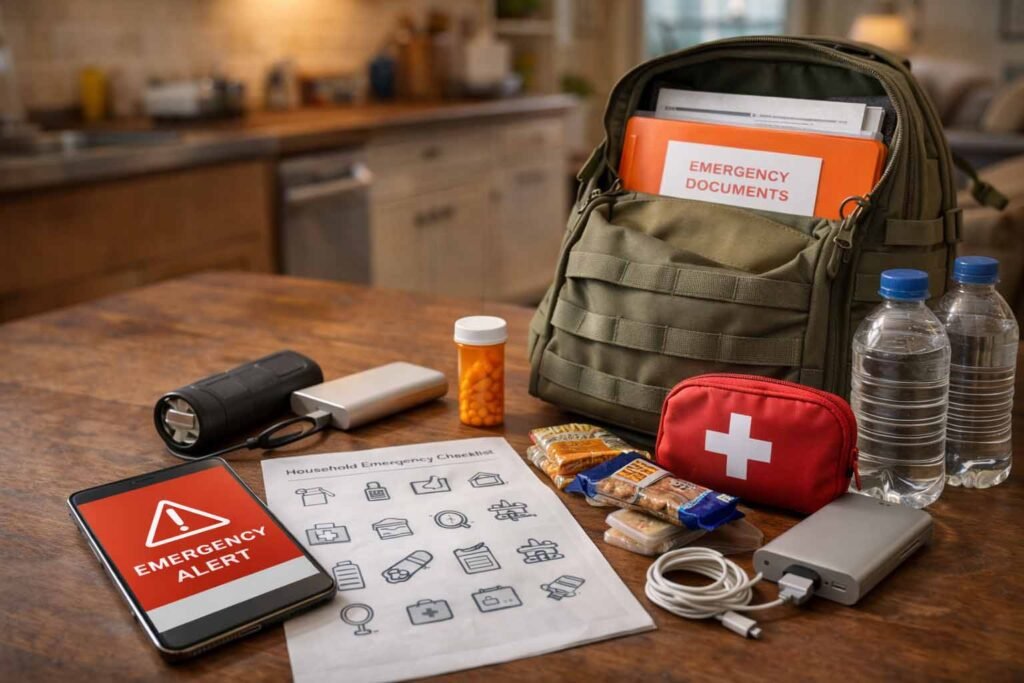
The author’s practical packing guidance (based on past evacuations):
- IDs, insurance info, and basic medications
- A small folder of key papers and photos
- Backup phone charger and a list of emergency contacts
Shelter-in-place guidance
Shelter-in-place guidance is typically used when leaving is more dangerous than stayingchemical incidents, air quality hazards, or an active immediate threat.
Shelter-in-place is not “doing nothing”; it is following specific safety steps, like sealing ventilation or staying away from windows depending on the hazard.
Shelter locations and services (what to expect)
When evacuations occur, shelter locations and services may be coordinated with organizations such as:
- American Red Cross
- Salvation Army Emergency Services
Shelters may provide basic supplies, charging, and information. The author recommends checking accessibility, pet policies, and medication storage guidance in advance when possible.
National Guard and Specialized Federal Support—When They Show Up and Why
People often assume the Guard appears for every declaration, but response depends on the severity and the needs of the jurisdiction.
National Guard deployment in plain terms
National Guard deployment can support:
- Logistics and supply distribution
- Traffic management and support functions
- Sandbagging, debris clearance support, and welfare checks
Residents ask: can the National Guard be activated? Yes under state authority (and in certain contexts, federal authority), but it depends on the situation and legal triggers.
The entity name National Guard is commonly used as shorthand, but the operational details matter.
Infrastructure and engineering support
In large disasters, the U.S. Army Corps of Engineers may assist with flood infrastructure, temporary power support, and large-scale logistics.
Scientific and environmental monitoring
For technical hazards and longer-term impacts:
- U.S. Geological Survey (USGS) provides earthquake and landslide monitoring.
- The Environmental Protection Agency (EPA) may support water/air monitoring or hazardous site coordination.
Public Health Emergencies (and How They Differ)
Some declarations are tied to health threats rather than storms. These are often misunderstood because the visible “damage” isn’t always physical.
Public health emergency measures vs disaster declarations
Public health emergency measures can be paired with (or distinct from) other emergency declarations. In these cases, communities may see emergency health measures and mandates depending on legal authority and local conditions.
Health guidance may involve:
- The Centers for Disease Control and Prevention (CDC) for national public health guidance
- The Local Public Health Department for local implementation and advisories
What residents typically see
Residents might see new clinics, public advisories, facility policies, or capacity changes. The author’s key tip is to focus on official guidance and avoid politicized interpretations; the practical goal is risk reduction and community continuity.
Money and Assistance: FEMA, SBA, and Eligibility Basics
After immediate danger passes, people quickly move to “How does recovery work?” This is where misunderstandings about assistance programs can create delays.
FEMA basics (what it covers and what it doesn’t)
The Federal Emergency Management Agency (FEMA) may offer support after certain qualifying declarations. People often ask what FEMA assistance covers; in general, it can include forms of temporary housing support, essential repairs, and critical needs assistance depending on eligibility and program rules.
This connects directly to disaster relief eligibility, which can vary based on:
- The type of declaration
- The area designated
- The applicant’s situation (homeowner, renter, insured/uninsured)
How to apply for disaster aid (step-by-step checklist)
The phrase how to apply for disaster aid matters because the process is often where people lose time. The author’s practical, “no-regrets” approach:
- Gather ID and proof of occupancy/ownership.
- Photograph damage immediately (safe conditions only).
- Document expenses and keep receipts.
- Record insurance claim numbers and correspondence.
SBA Disaster Assistance for homeowners, renters, and businesses
The Small Business Administration (SBA) Disaster Assistance program can provide loans for physical damage and, for businesses, working capital. The author notes that SBA assistance can complement FEMA; it is not only for large companies.
Insurance and documentation (avoid claim delays)
People also ask does it affect insurance claims. A declaration can support event verification and timelines, but insurance coverage depends on the policy. To reduce friction, the author emphasizes what documents residents should keep:
- Photos and videos of damage
- Receipts for repairs and temporary lodging
- Contractor estimates and invoices
- Names, dates, and reference numbers from insurers
Consumer Protections: Price Gouging, Contracts, and Procurement
The post-disaster period can attract opportunistic behavior. The author has repeatedly seen confusion about what is allowed, what is illegal, and what to report.
Price gouging rules during emergencies
Many states activate price gouging laws during emergencies. Residents often ask how price gouging rules work. While details differ by state, the practical best practice is consistent:
- Keep receipts
- Photograph posted prices when possible
- Report suspicious behavior through official consumer protection channels
Emergency procurement rules (how governments buy fast)
Government response can also involve accelerated purchasing. Emergency procurement rules may authorize rapid buying of supplies, equipment, and services.
This often intersects with emergency procurement and contracts, which can be streamlined but still subject to oversight and audit later. This is one reason “slow paperwork” may become “fast paperwork” after a declaration.
Utilities, Transportation, and Repairs: What Gets Prioritized First
This is one of the most emotionally charged recovery issues: “Why does that neighborhood get power first?” The author’s experience is that the answer is rarely political; it is usually logistical.
Utility restoration and what “priority” means
Utility restoration priority typically focuses on critical infrastructure: hospitals, water systems, emergency services, and major substations. People ask can utilities be shut off or restored first; sometimes shutoffs happen to prevent fires or hazards, and restoration follows a safety-first sequence.
Emergency transportation coordination
During major incidents, emergency transportation coordination can involve state agencies and federal partners.
The U.S. Department of Transportation (USDOT) may provide guidance or coordination support, while aviation disruptions can involve the Federal Aviation Administration (FAA) for airspace and airport operations.
Emergency infrastructure repairs
Large disasters can trigger emergency infrastructure repairs roads, bridges, water systems, and public buildings. Residents should look for official detour maps and “access allowed” rules for impacted zones.
Disaster debris removal
Disaster debris removal is more complex than it looks. Communities may require separation of hazardous materials, appliances, and vegetative debris. The author advises residents to verify contractor legitimacy and follow local curbside rules to avoid fines and delays.
Duration, Extensions, and the End Date: How Long an Emergency Lasts
People want certainty. A declaration can feel like an indefinite label, but the operational reality is more structured.
Emergency declaration duration (what determines it)
Emergency declaration duration varies. The common question how long an emergency lasts is best answered by checking:
- The order’s stated end date (if provided)
- Conditions on the ground
- Funding and operational needs
Emergency extension criteria
If an emergency continues, leaders may use emergency extension criteria such as ongoing hazards, sheltering needs, infrastructure instability, or continued response operations.
When an emergency declaration ends (and what changes)
People ask when an emergency declaration ends because they want to know what changes. Often, restrictions expire, but recovery programs may continue into the emergency recovery phase especially when housing, repairs, or public infrastructure are still in progress.
State vs Federal Declarations: Key Differences That Affect People
This comparison matters because it changes the type of help and the chain of operations.
Differences between state and federal declarations
The differences between state and federal declarations often look like this:
- State: triggers operational powers, coordination, and restrictions at the state/local level.
- Federal: expands assistance programs and interagency support, especially around FEMA and SBA.
Federal engagement may involve coordination signals from The White House and the broader federal system, but local orders still control local rules.
Disaster proclamation vs emergency declaration (terminology)
People sometimes ask what is a disaster proclamation. Terminology varies by state and jurisdiction. The author’s practical advice is to focus less on the label and more on the written authority, scope, and instructions.

How to Check Official Status and Avoid Misinformation
This is where the author believes many people can reduce stress immediately. The goal is to replace rumors with verified sources.
How to check official emergency status (the author’s routine)
To answer how to check official emergency status, the author uses a three-layer check:
- City/county official website (often managed through the mayor/county executive channels)
- The state emergency management site and updates from the governor’s office
- Federal pages when relevant (FEMA, related agencies)
This routine is especially useful when multiple messages circulate.
Emergency alerts and warning systems (where alerts originate)
Understanding emergency alerts and warning systems helps residents trust the right messages. High-level communication standards and systems may involve the Federal Communications Commission (FCC), while urgent broadcast alerts can run through the Emergency Alert System (EAS).
Storm and hazard tracking sources the author trusts
For hazard verification:
- National Weather Service (NWS) (weather hazards)
- National Hurricane Center (NHC) (tropical systems)
- U.S. Geological Survey (USGS) (earthquakes)
Personal Practical Checklists During an Emergency (Real-World, Not Alarmist)
The 10-minute checklist (immediately after hearing the news)
- Confirm the issuer and read the written order (not summaries).
- Identify restrictions, shelter instructions, and evacuation zones.
- Notify family and confirm a contact plan.
- Charge devices, prepare documents, and check on neighbors.
H5: “Read the Order” callout (quick reminder)
A declaration headline is not enough. The author always finds the PDF or official page that includes the actual order language.
The 24-hour checklist (if conditions worsen)
- Backup water, shelf-stable food, and key medications.
- Photograph valuables and key home areas for documentation.
- Map two routes and confirm closures and detours.
- Follow official briefings only.
The recovery checklist (first week after impact)
- Document damage safely and systematically.
- Apply for eligible assistance and track confirmations.
- Vet contractors and stay alert to price gouging risks.
- Monitor debris schedules and utility restoration estimates.
H6: Mini glossary (quick definitions)
- Emergency Operations Center (EOC): the coordination hub for response decisions
- ICS/NIMS: standardized systems for interagency coordination
- Mutual aid: agreements allowing shared resources across jurisdictions
Important Recovery Functions People Don’t See (But Feel)
The author has found that recovery improves when people understand the “invisible” work that a declaration can accelerate:
- Continuity of government plans that keep basic services operating
- Emergency volunteer coordination so donations and help arrive where needed
- Emergency transportation coordination so supplies move effectively
- Emergency infrastructure repairs prioritized by risk and public need
In other words, a declaration isn’t only about restrictions. It can be a mechanism for stabilizing community systems.
FAQs About State of Emergency Declarations in the U.S.
1) Who can declare an emergency in a specific area?
Usually local leaders (city/county) can declare for their jurisdiction, and the governor can declare at the state level. Federal involvement may follow based on severity and program thresholds.
2) What happens after a declaration does anything change immediately?
Yes: response operations can accelerate quickly, especially coordination and spending authority. But restrictions apply only if specifically ordered.
3) How long does an emergency last?
It depends on the written order and conditions. Many are days to weeks, with extensions possible when justified.
4) Differences between state and federal declarations why does it matter?
State declarations often activate local/state response powers and restrictions; federal declarations often expand assistance programs and interagency support.
5) Does a declaration create a curfew automatically?
No. A curfew must be explicitly stated with hours, geography, and enforcement rules.
6) Can businesses be forced to close during an emergency?
Sometimes yes, but only if an executive order, health order, or specific directive requires closure or capacity limits.
7) Can roads be closed legally or travel restricted?
Yes, especially for safety, evacuation routing, and responder access. Details should be confirmed through official notices.
8) Can police enforce evacuation orders?
Enforcement varies. Mandatory orders may involve access restrictions, roadblocks, or controlled re-entry for safety.
9) What FEMA assistance covers, and how does a person apply for aid?
FEMA may support temporary housing and essential needs after qualifying declarations. Applicants should use official FEMA channels and keep careful documentation.
10) Does it affect insurance claims, and what documents should residents keep?
A declaration can support event verification, but coverage depends on the policy. Keep photos, receipts, claim numbers, and proof of occupancy/ownership.
Author Bio
Jordan Blake is a U.S.-focused public-safety writer who translates emergency announcements into practical, step-by-step guidance for everyday residents, renters, and small businesses.
Published by: Ahmed Saeed