




Disclaimer: This article is for general informational and educational purposes only. Soccer rules and competition guidance can vary by league and level, and officiating decisions depend on real-time judgment and official protocols.
If someone has ever watched a match and blurted out, “Wait why did the ref stop play there?” they’re in good company.
This guide delivers the offside rule explained in plain English without the heavy jargon so new fans can follow the logic, understand why goals get called back, and feel more confident watching Major League Soccer (MLS) or any other competition on TV.
Offside rule explained in one sentence
Offside is called when an attacker is ahead of the defense at the instant a teammate plays the ball and that attacker becomes involved in the play.
That single sentence hides a lot of detail, so here’s the practical translation new fans actually use: the referee team is looking for two things at the same time position (where the attacker is) and involvement (what the attacker does next). If either piece is missing, play continues.
A helpful way to think about it is a “freeze-frame.” The official mentally pauses the action at the moment the ball is played by the passer. Where the attacker is standing in that freeze-frame matters. But it only becomes a problem if the attacker then affects the play.
This is why offside feels confusing at first: the whistle often comes after the pass, sometimes even after a shot or goal. The decision, however, is anchored to a specific instant then judged based on what the attacker does after.
What counts as offside in soccer
To answer what counts as offside in soccer, new fans should rely on a simple two-part test:
- Position test: Was the attacker in an offside position at the moment the teammate played the ball?
- Involvement test: Did that attacker then interfere with play, interfere with an opponent, or gain an advantage?
A common misunderstanding is that being “ahead” automatically means offside. It does not. Many attackers stand in advanced spaces all the time and nothing is called because they never get involved in the play in a way that meets the criteria.
This distinction matters because it explains a lot of “why didn’t they call it?” moments. The law is not about punishing a player for standing somewhere; it’s about preventing a player from benefiting unfairly from being in that position when the ball is played.
Offsides vs offside wording
In American sports talk, people often say “offsides,” especially if they come from football or hockey. In soccer, the formal term is offsides vs offside wording commentators will understand both, but the Laws use “offside.”
New fans don’t need to stress about vocabulary. It’s more useful to learn the logic and recognize the patterns. Once the concept clicks, the wording sorts itself out.
The 3 building blocks new fans must know
Offside position vs offside offense
The cleanest way to learn offside is to separate offside position vs offside offense.
- Offside position = where the attacker is when the ball is played by a teammate.
- Offside offense = what the attacker does next (the involvement piece).
This is why an attacker can look “clearly offside” and still not be penalized if the ball never goes to them and they never affect the opponents.
Second-to-last defender rule
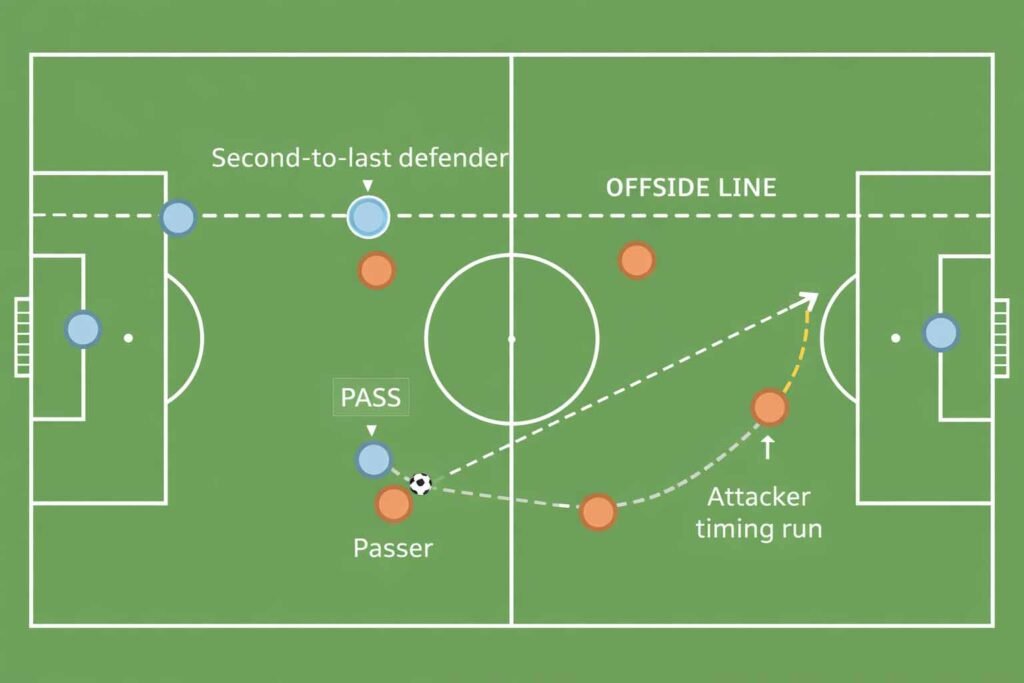
Most offside decisions are explained by the second-to-last defender rule. The offside line is set by the second-to-last opponent, because the last opponent is often the goalkeeper.
A beginner-friendly translation:
- If any part of the attacker that can legally score (head, body, feet) is ahead of the second-to-last opponent at the moment of the pass, the attacker may be in an offside position.
- Arms/hands don’t count for attackers when determining position (they can’t score with them).
Edge case that surprises people: if the goalkeeper is far off the goal line, the “last opponent” might be a field player, and the second-to-last opponent could be the goalkeeper. That changes the line in ways TV viewers don’t expect.
Level with the defender meaning
New fans often ask what “level” means. The level with the defender meaning is straightforward: if the attacker is even with the second-to-last opponent, that is considered onside. Level is not ahead.
This is why replay angles can be misleading. A player who looks “barely ahead” from one camera angle can be perfectly level from another. In tight situations, technology and frame selection become important later (more on that in the VAR section).
Attacker behind the ball exception
There’s another key shortcut called the attacker behind the ball exception: if the attacker is behind (or level with) the ball when the teammate plays it, the attacker can’t be offside even if the defenders are deeper.
This happens on dribbles and cutbacks. If the ball is closer to the goal line than the attacker, the attacker is safe in terms of position.
Timing is everything
Timing of the pass rule
If offside feels inconsistent, it’s usually because the viewer is watching the wrong moment. The timing of the pass rule is the core: the judgment is based on where players are when the passer touches the ball, not where they are when the receiver controls it.
That means an attacker can start onside, sprint past defenders, and still be legal because the sprint happens after the pass is played.
Moment the ball is played
The best mental model is the freeze-frame at the moment the ball is played. New fans can practice this while watching: when the passer winds up to play a through ball, pause mentally. That’s the instant that matters.
Two examples that make the timing feel real:
- On a chipped pass over the top, the attacker might look offside because they’re already beyond the defense when the ball is halfway there. But the call depends on where they were when the chip was struck.
- On a quick one-touch slip pass, the attacker can be level in the freeze-frame, then two yards beyond the line by the time the ball arrives still legal.
Can’t be offside in own half
One more helpful rule: can’t be offside in own half. If the attacker is in their own half at the instant the teammate plays the ball, offside is not possible on that play.
This is why long outlet passes sometimes look “obviously offside” to new viewers, but aren’t because the runner started in their own half.
“Involved in play” in plain English
A practical shortcut many coaches and analysts use for beginners is: Did the attacker affect the play, affect an opponent, or benefit from being there? That’s the heart of involvement.
Active involvement in play definition
The active involvement in play definition can be broken into three buckets that the Laws recognize:
- Interfering with play (touching/playing the ball from a teammate)
- Interfering with an opponent (impacting an opponent’s ability to play)
- Gaining an advantage (benefiting from a rebound/deflection after being in an offside position)
It helps to picture the offside position as “potential energy” and involvement as “turning it on.” Many plays have the potential for offside, but never switch on because the attacker does not become involved.
Interfering with play criteria
The interfering with play criteria is the simplest: the attacker in an offside position plays or touches the ball that was passed by a teammate. That’s the classic whistle.
New fans can treat this like the “obvious case” category. If the offside-positioned attacker receives the ball and takes an action, the call is usually straightforward.
Interfering with an opponent criteria
The interfering with an opponent criteria is where confusion starts, because the attacker might never touch the ball. Examples include:
- blocking the goalkeeper’s line of sight on a shot,
- challenging a defender for the ball,
- making a move that causes an opponent to react as if contested.
This is why a player standing near a keeper can be called offside even without touching the ball. The player changed what the defender or keeper could do.
Gaining an advantage interpretation
The gaining an advantage interpretation often appears on rebounds, deflections, or saves. If an attacker was in an offside position and then plays a ball that rebounds or deflects to them (from a post, crossbar, or an opponent) and benefits from that earlier position, the offense can be called.
For beginners, the simplest way to remember it: if an attacker was offside-positioned when the teammate played the ball, they don’t get to “profit” from the chaos that happens next.
The big gotcha: defender touches the ball
Deliberate play vs deflection
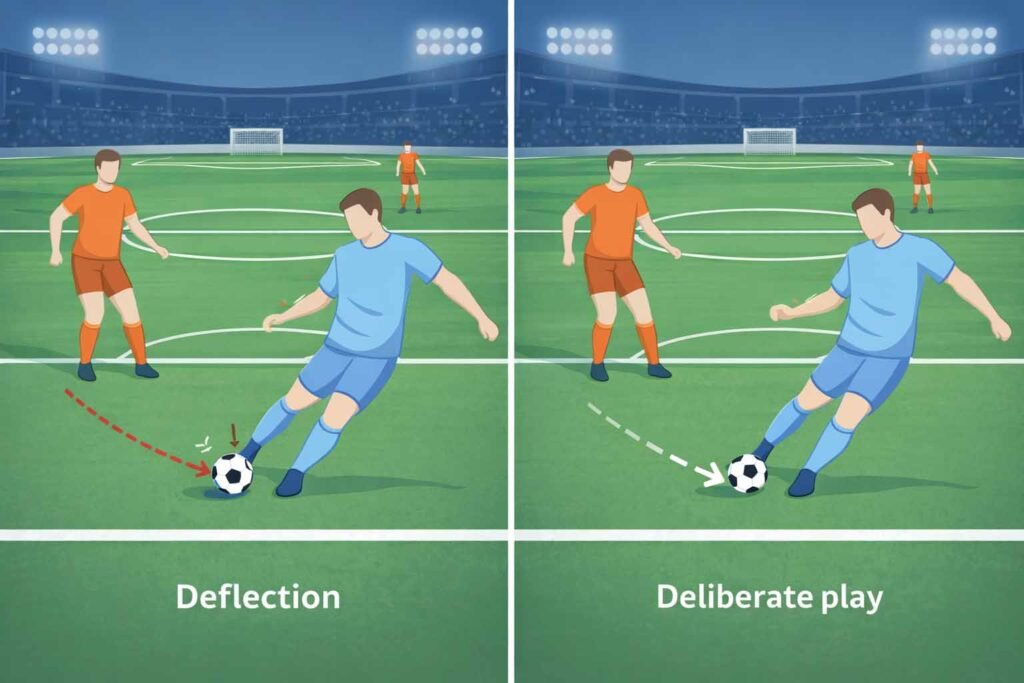
One of the most debated moments in modern soccer is deliberate play vs deflection. New viewers see a defender touch the ball and assume the offside is “reset.” Sometimes it is. Sometimes it isn’t.
A practical checklist helps:
- Deliberate play: the defender had control, time, and a purposeful action (for example, intentionally playing the ball with a clear attempt to direct it).
- Deflection: the ball hits the defender without real control or intentional play (a ricochet, a block where the defender is reacting but not really controlling).
Why this matters: a deliberate play can “restart” who is eligible to receive the ball without offside being applied from the earlier pass; a deflection typically does not.
Rebound off the post scenario
The rebound off the post scenario is a classic gaining-advantage case. If the ball strikes the goalpost or crossbar and falls to an attacker who was in an offside position at the time of the shot/pass, that attacker may be penalized if they become involved.
New fans can remember this with a simple phrase: “A bounce off the frame doesn’t erase what happened at the moment of the shot.”
Three restart facts every new fan should know
Indirect free kick restart
An offside decision leads to an indirect free kick restart for the defending team. That means the team awarded the kick cannot score directly from that kick without the ball touching another player.
This is useful because it answers a frequent misconception: offside is not a foul like tripping, and it isn’t a penalty kick situation. It’s a stoppage that gives possession to the defenders.
Where offside is taken (placement basics)
New fans often wonder why the free kick appears to happen in unexpected spots. The restart is generally taken from the location where the offside offense occurred where the involved attacker touched or interfered rather than where the pass originated.
That distinction becomes very visible when the ball is played forward, but the player becomes involved slightly later as they chase it.
Where offside happens on the field
Offside near midfield
Offside near midfield is common during transitions because teams often stretch the field there defenders hold a line, attackers try to time runs behind it, and a single step can flip a call.
It also happens because cameras are wider and angles are less forgiving at midfield. What looks clear to a viewer can be a close call in reality.
Offside in the penalty area
Offside in the penalty area feels dramatic because it often wipes out goals or big chances. The rule, however, is identical. The stakes are higher, not the criteria.
In the box, involvement questions are more frequent too screening the goalkeeper, blocking defenders, or influencing a clearance can all trigger an offside offense even without a touch.
Three classic game situations (and how new fans can read them)
Offside on a through ball
Offside on a through ball is the most common “beginner confusion” moment. Here’s the film-room way to view it:
- Identify the likely passer.
- As the passer is about to release the ball, imagine a pause.
- Compare the runner’s position to the second-to-last opponent in that instant.
This is also exactly what the Assistant Referee (AR) is tracking running the touchline, staying level, and watching the timing.
Breakaway offside situation
A breakaway offside situation is where commentators say a player “timed the run.” The attacker often slows slightly, staying level, then explodes forward exactly as the pass is struck.
This is one of the best moments for learning, because it teaches the difference between “running fast” and “running at the right time.” When a viewer learns to watch the passer’s touch instead of the receiver’s sprint, the whole rule gets easier.
Offside on quick counterattacks
Offside on quick counterattacks is common because defenders often hold a high line to compress space and press. When the ball turns over, the attacking team tries to exploit the space behind that line immediately. The faster the play, the thinner the margins.
This is also why VAR involvement has increased: tight counters produce tight lines, and tight lines produce replays.
Set pieces and the “no offside” exceptions
Offside from a throw-in exception
There is an offside from a throw-in exception: players cannot be penalized for offside directly from a throw-in. New fans should treat this as a simple rule of thumb if the ball comes from a throw-in, offside is not the reason for a stoppage on that immediate play.
Offside from a goal kick exception
There is also an offside from a goal kick exception. This keeps restarts practical and avoids turning goal kicks into constant offside traps.
Offside from a corner kick exception
The offside from a corner kick exception is another common surprise. Many people assume attackers near goal are “automatically offside.” Corner kicks prove otherwise: attackers can stand as advanced as they want, and offside still does not apply on the corner itself.
Offside on free kicks
Unlike those exceptions, offside on free kicks is absolutely a thing. That’s why teams frequently set a line and step up on free kicks outside the box.
A useful beginner tip: if the ball is put back into play as a free kick (not a corner, goal kick, or throw), then offside rules apply normally.
How officials actually call it (what viewers can notice)
Assistant referee flag signal
The assistant referee flag signal is usually the first visible indicator: the AR raises the flag to indicate offside, and then the center referee stops play and indicates the indirect free kick.
Delayed flag practice
Many viewers notice the flag feels “late.” That’s often because of delayed flag practice: when a decision is very close, the AR may wait a moment, allowing the attack to finish. This avoids stopping a potentially legitimate chance and allows technology to assist if needed.
What VAR changes (simple explanation)
Video Assistant Referee (VAR) can review tight offside decisions, especially those that lead to goals or clear chances. That review process is one reason modern offside feels slower than what longtime fans remember.
VAR, technology, and why the lines look weird on TV
A lot of new American fans first encounter offside debates through replay graphics. It can look overly technical, but the purpose is simple: make tight decisions more accurate and consistent.
Video Assistant Referee (VAR)
VAR typically checks:
- whether the attacker was ahead at the moment of the pass,
- and whether the attacking phase led to a goal or a major incident.
VAR does not re-referee every play; it intervenes in specific situations defined by protocol.
Goal Line Technology (GLT)
Goal Line Technology (GLT) is often confused with offside. GLT answers a different question: did the ball fully cross the goal line? It does not determine offside position.
Referee Communication System (RCS)
The Referee Communication System (RCS) helps the referee team coordinate in real time. When a check happens, communication is part of why the decision can be explained and applied consistently.
Semi-automated offside technology (context)
Some competitions have implemented semi-automated tools to speed up offside checks. These systems use tracking to estimate positions quickly, then officials confirm. The viewer sees the “lines,” but the goal is simply to reduce human error on the tightest calls.
Strategy corner: why teams “play the line”
Offside line concept
The offside line concept is just the practical outcome of the second-to-last defender rule. Defenders try to move together so the line is clear and attackers have less space behind them.
When a team holds its line well, it can shrink the field.
Offside trap strategy
The offside trap strategy is when defenders step up together at the moment a pass is expected, trying to catch an attacker ahead of the line at the instant the ball is played.
It can be brilliant when coordinated and disastrous if one defender hesitates and keeps everyone onside.
Goalkeeper position and offside
Goalkeeper position and offside matters more than new fans assume. A goalkeeper who plays high can change who counts as the last and second-to-last opponent. This is one reason some offside calls look “wrong” to casual viewers until they see the wide replay.
Watch smarter in 60 seconds (practical TV tips)
“Daylight” myth clarification
Many people believe the attacker must have visible space between themselves and the defender to be offside. That’s false. The “daylight” myth clarification is simple: offside is about being ahead, not about visible daylight.
Soccer offside diagram idea
A great way to make offside click is one clean visual. Here’s a soccer offside diagram idea package that improves understanding without cluttering the article:
- a simple field diagram showing the second-to-last defender and offside line,
- a freeze-frame graphic labeled “moment the ball is played,”
- a side-by-side graphic explaining deliberate play vs deflection.
Common offside mistakes for new fans
Here are common offside mistakes for new fans that cause most confusion:
- watching where the attacker is when the ball arrives instead of when it was passed,
- assuming the pass direction determines offside,
- thinking a player must touch the ball to be penalized,
- forgetting the exceptions on throw-ins, goal kicks, and corners.
Beginner soccer rules guide
If this is part of a larger learning journey, it helps to link this article to a beginner soccer rules guide that covers fouls, handball basics, stoppage time, and substitutions. Offside becomes easier when it’s not learned in isolation.
USA context—where fans hear these conversations
In the United States, offside debates show up everywhere: in Major League Soccer (MLS) broadcasts, National Women’s Soccer League (NWSL) highlights, and even NCAA Soccer matches where new fans are learning the game alongside student crowds.
Younger players see it in MLS NEXT, and national-team followers hear it during U.S. Men’s National Team (USMNT) and U.S. Women’s National Team (USWNT) matches.
Internationally, the same arguments pop up across CONCACAF, UEFA, the FIFA World Cup, and the FIFA Women’s World Cup.
Fans also see it constantly in the CONCACAF Gold Cup, the CONCACAF Nations League, the U.S. Open Cup, and the MLS Cup Playoffs and then again in European competitions like the Premier League, the UEFA Champions League, and the UEFA Europa League.
Who makes the rules and who enforces them
Offside feels less arbitrary when fans know who sets the standards.
- The International Football Association Board (IFAB) writes the official Laws of the Game, including the offside law.
- Fédération Internationale de Football Association (FIFA) organizes major global competitions and applies those laws.
- In the U.S., the U.S. Soccer Federation (USSF) and the USSF Referee Program support implementation, education, and referee development.
- At the professional level, leagues often rely on dedicated officiating bodies such as the Professional Referee Organization (PRO).
- In England, a commonly referenced organization for professional officials is Professional Game Match Officials Limited (PGMOL), which fans hear about when following European coverage.
This ecosystem matters because it explains why the law is consistent, but interpretations and emphasis can evolve especially with technology and competition protocols.
Intent coverage map (quick answers new fans actually search)
why was that goal disallowed
Usually because the attacker was in an offside position at the moment of the pass and then became involved in play.
how do refs decide offside so fast
They rely on positioning, experience, and teamwork especially the AR staying aligned with the defensive line.
what does “in line” mean in soccer
It means the attacker is level with the defender, not ahead, at the instant the pass is played.
is a player offside if they don’t touch the ball
Yes, if they interfere with an opponent or gain an advantage despite not touching it.
can you be offside if the ball comes off a defender
Yes, depending on whether the touch was a deflection or a deliberate play that changes eligibility.
what happens after an offside call
Play stops and the defending team restarts with an indirect free kick.
where is the free kick taken after offside
It is taken from the spot where the offside offense occurred, which can be different from where the pass was made.
why do teams hold a high line
To compress space, press higher, and increase the chance of catching runners offside.
what is “playing the opponent” in offside
It describes actions that affect an opponent’s ability to play the ball often without touching it.
is being near the goalie automatically offside
No. Being near the goalkeeper alone is not enough; position and involvement both must be present.
can a pass backward still be offside
Yes, because offside is judged by the attacker’s position relative to opponents and the ball at the moment of the pass.
does the pass direction matter or the player’s position
The attacker’s position at the instant the ball is played matters more than the direction of the pass.
what is the easiest way to spot offside on TV
Watch the second-to-last defender and “freeze” the moment the passer touches the ball.
why do commentators say “he timed his run”
Because the attacker waited to move beyond the line until the instant the pass was made.
what is considered blocking the keeper’s view
Standing in the goalkeeper’s line of sight in a way that affects the keeper’s ability to react to a shot.
can a player be offside on a rebound shot
Yes, especially if the rebound falls to an attacker who was offside-positioned when the original shot was taken.
why do players stop running when a flag goes up
They expect play to stop and often avoid unnecessary collisions or exhaustion.
why do officials sometimes let play continue
They use delayed flag practice in tight situations to avoid stopping a legal attack and to allow review if needed.
do offside rules change in youth leagues
The core concept is typically the same, though local rules and enforcement emphasis can vary by age and competition.
what is the difference between offside and foul
Offside is a positioning/involvement offense; a foul involves illegal contact or misconduct.
is offside a penalty or just a turnover
It is a stoppage that gives possession to the defending team via an indirect free kick.
can a defender step up to catch someone offside
Yes, that is essentially the offside trap strategy.
why does offside exist in soccer
To prevent attackers from camping near goal and to keep spacing, tactics, and flow balanced.
what does “gaining an advantage” mean in real play
It refers to benefiting from being offside-positioned when a rebound or deflection makes the ball playable to that attacker.
how close is “too close” to be called offside
If the attacker is level, they are onside; if they are ahead by any legal scoring part, they may be offside tight calls may go to review.
can you be offside on a long goal kick
No, because there is an offside from a goal kick exception.
is a player offside on a corner cross
No, because there is an offside from a corner kick exception.
is a player offside on a throw from the sideline
No, because there is an offside from a throw-in exception.
what does the referee signal for offside
The AR raises a flag and the CR indicates the direction of the indirect free kick.
how do tight offside decisions get reviewed
They are checked using VAR protocols and replay frames to confirm the moment the ball is played and the attacker’s position.
Conclusion
Offside stops feeling mysterious when new fans learn to separate position from involvement. The practical routine is simple: identify the passer, freeze the instant the pass is made, compare the runner to the second-to-last opponent, then ask whether that runner actually affected play.
That habit also makes broadcasts more fun. Instead of waiting for the replay to tell the story, viewers can anticipate the decision and understand why a goal stands or disappears.
If learning continues beyond this article, it helps to connect this topic to a beginner soccer rules guide and a basic explainer on technology so the bigger picture feels coherent.
FAQs
1) Can you be offside if you’re level with the last defender?
Direct answer: No level is considered onside in standard interpretation.
- The key comparison is to the second-to-last opponent.
- “Level” means not ahead at the moment the ball is played.
- Camera angles can make “level” look off from certain views.
- Watch-for example: a runner looks past the line on TV, but the freeze-frame shows shoulders even.
2) Can you be offside if you’re not touching the ball?
Direct answer: Yes touching the ball is not required if involvement criteria are met.
- Interfering with an opponent is a major trigger.
- Screening the goalkeeper can count without touching the ball.
- Making a challenge that forces a defender to react can be enough.
- Watch-for example: a player stands between keeper and shooter, never touches it, but affects the save attempt.
3) Is it offside if the pass goes backward?
Direct answer: It can be offside depends on position and involvement, not just pass direction.
- Backward passes still have a “moment the ball is played.”
- A player can be ahead of the defense even on a backward pass.
- The attacker behind the ball exception can prevent offside in some cutback plays.
- Watch-for example: a winger cuts it back, but the striker started ahead of the defenders in the freeze-frame.
4) Where does the free kick happen after an offside call?
Direct answer: Usually from where the offside offense occurred, not where the pass began.
- If the offside offense is interfering with play, it’s near where the attacker plays the ball.
- If it’s interfering with an opponent, it can be where the interference occurs.
- This is why restarts can appear “odd” to new viewers.
- Watch-for example: a runner chases a pass, but the kick is taken from where the runner challenged a defender.
5) Why do refs wait to raise the flag sometimes?
Direct answer: They may delay the flag in close situations to allow the attack to finish and be checked if needed.
- This prevents stopping legal attacks prematurely.
- VAR can confirm tight decisions afterward in major incidents.
- It is most common on breakaways and fast counters.
- Watch-for example: play continues to a shot, then the flag goes up after the outcome.
6) Is there offside on corner kicks in MLS and NWSL?
Direct answer: No corner kicks are an exception, including in top U.S. leagues.
- Attackers can position themselves near goal on corners.
- Offside rules return once the ball is played in open play afterward.
- This often surprises fans coming from other sports.
- Watch-for example: attackers line up near the goalmouth on a corner with no offside call.
7) Can you be offside if a defender touches the ball?
Direct answer: It depends deliberate play can change the situation, while a deflection usually does not.
- A controlled, purposeful defensive play can reset who can receive.
- A ricochet or accidental deflection often does not.
- The distinction is why replays focus on “control.”
- Watch-for example: a defender sticks a leg out and the ball ricochets to an offside-positioned attacker.
8) Does the goalkeeper “count” as a defender for offside?
Direct answer: Yes offside is based on the second-to-last opponent, and the goalkeeper may or may not be one of them.
- If the keeper is deepest, the line is usually set by the last field defender.
- If the keeper is high, the line can change unexpectedly.
- This is why wide-angle replays matter.
- Watch-for example: a keeper sweeps high and a defender on the line becomes the last opponent.
9) Why does offside exist at all?
Direct answer: To prevent “goal-hanging” and keep the sport’s spacing and tactics balanced.
- Without offside, attackers could camp near the goal.
- Defenders would be forced to stay deep, reducing midfield play.
- The rule preserves flow and strategic movement.
- Watch-for example: teams playing higher up the field without constantly worrying about cherry-pickers.
10) How accurate is VAR for offside, and why does it take time?
Direct answer: VAR improves accuracy on tight calls, but frame selection, angles, and protocol steps add time.
- The review must find the correct moment the ball is played.
- Officials confirm which body part is relevant for the line.
- The process aims to be consistent, not instant.
- Watch-for example: long checks when the pass timing and runner’s shoulder position are both close.
Author Bio
Author: Kate Smithen writes beginner-friendly sports explainers that translate complex rules into plain English for new fans.
Published by: Ahmed Saeed