

Disclaimer: This article is for general educational purposes only and does not provide medical, nutrition, or health advice. For personalized guidance, consult a qualified professional.
I used to think cooking for myself “should” be easy until I looked in my fridge on a Thursday night and realized I’d managed to buy ingredients for three different recipes and finish none of them.
That’s the moment I built an easy meal prep for one routine I could actually stick to: a repeatable 20-minute method that produces flexible building blocks instead of a week of identical meals.
I’m not a chef, and I’m not here to sell a perfect lifestyle. I’m someone who has tried the Sunday-mega-prep thing, hated it, and quietly returned to takeout.
What finally worked was treating meals like a system: a few components that can become multiple lunches and dinners, with minimal cleanup and almost no wasted groceries.
This post walks you through exactly how I do it what I buy, what I cook, how I store it, and how I keep it interesting so you can copy the framework and adapt it to your own tastes.
What you’ll get: a time-saving kitchen workflow, a realistic shopping strategy, a minute-by-minute routine, and a full week of examples you can mix and match.
Introduction — Why I Built This 20-Minute System
The “cook a full recipe” approach kept failing me for a simple reason: recipes assume you’re feeding more than one person, or that you love eating the same thing five nights in a row.
I don’t. When I forced it, I ended up with half-used herbs, leftover sauces I forgot about, and a growing sense that I wasn’t “good at” cooking. The truth was simpler: my process didn’t fit my reality.
So I started testing a different approach in a tiny kitchen with a small fridge, basic tools, and the kinds of staples most U.S. grocery stores carry.
I built a system that supports budget-friendly cooking for one without turning my weekend into a part-time job. It’s based on tiny wins: cook one protein, prep one vegetable, get one carb base ready, and use one sauce or seasoning to make it taste like something you’d choose not something you’re tolerating.
I also learned that when you live alone, success isn’t about doing more. It’s about removing friction: fewer steps, fewer dishes, fewer “what should I cook?” moments. This system is designed for that.
Who this system is for (and who it isn’t)
This is for people who want a realistic routine: busy professionals, students, anyone in a small apartment, anyone who wants meals that feel fresh without elaborate planning.
If you’re brand-new to cooking, it’s also ideal because it gives you repeatable patterns rather than complicated recipes.
This is not for someone who loves spending hours cooking as a hobby or wants an elaborate weekly menu with eight different dishes. You can absolutely do that but this system is about being consistent, not impressive.
What “success” looks like
For me, success looks like this: I open the fridge and see 3–5 meals worth of options, plus one “backup” meal I can heat in minutes. I waste less food. I spend less on last-minute delivery. And I feel calm at 6 p.m. because dinner is already halfway done.
The Core Method — “Easy Meal Prep for One” in 20 Minutes
The system is intentionally small. It’s not “prep 20 containers.” It’s “prep a few components that become multiple meals.” I treat it as solo meal planning with guardrails, not a strict schedule.
The framework I follow every time: protein + veg + carb formula
When I stopped thinking in recipes and started thinking in the protein + veg + carb formula, everything got easier. It’s basically the balanced plate method without the perfectionism: I aim for a satisfying protein, a vegetable I’ll actually eat, and a carb that makes the meal feel complete. That’s it.
This framework prevents random shopping because it tells you what to buy. It also makes portioning intuitive: you’re building plates and bowls from three categories. When I’m tired, I don’t need inspiration just a protein, a vegetable, and a carb base.
My “mix-and-match meal components” approach
Instead of making one full dish, I do meal component prep: cook a protein, prepare vegetables, and get a carb base ready.
These are the mix-and-match meal components that can become different meals with tiny changes different sauces, different seasonings, a different format (bowl vs. wrap vs. salad).
This is also why single-serving batch cooking works so well: you’re making just enough to cover a few meals, not a week of leftovers you’ll resent.
The weekly cadence: a quick weekly meal plan that stays flexible
I aim for a quick weekly meal plan that’s flexible. Most weeks I choose two proteins (one “instant” like canned fish and one cooked), two vegetables (one frozen, one fresh), one grain, and two sauces.
It’s a loose plan that survives real life: if I eat out once or skip a day, nothing goes bad because I didn’t overbuy.
Setup Once — Tools, Containers, and a Smart Station
I used to believe I needed special gadgets to meal prep. I don’t. I needed fewer obstacles.
Equipment I actually use
- Microwave oven: My fastest path to microwave-friendly lunches and quick reheats.
- Rice cooker: For hands-off grains and reliable pre-cooked grains planning.
- Cast iron skillet: The hero for fast browning and skillet meals for one.
- Sheet pan: Essential for sheet pan cooking basics (roast once, eat twice).
- Air fryer: Optional, but great for quick proteins and crisp vegetables.
- One “hands-off” cooker: I rotate between an Instant Pot, Ninja Foodi, or Crock-Pot depending on the season and my schedule.
The key is not owning everything it’s choosing tools that reduce your active cooking time.
Storage that makes this work
This system only works if storage is easy. I keep a small set of Meal prep containers and Glass storage containers because glass doesn’t hold smells and I can see what’s inside. For lunches, I use meal portioning containers so I don’t accidentally create a mountain of portion-controlled leftovers I won’t finish.
For anything that needs to stay crisp, I use Mason jars they’re perfect for salads and grab-and-go items.
Micro-habit: “reset the station”
My biggest sustainability trick is a two-minute reset: wipe the counter, rinse the cutting board, and put containers back. That’s it. It keeps minimal cleanup cooking real, not aspirational, and it makes it easier to do the routine again next week.
The Grocery Strategy — Buy Like a Solo Eater
I used to shop like I was cooking for a family: big packages, too many “maybe I’ll make this” ingredients, and good intentions. Now I shop like a solo eater: flexible staples, small quantities, and ingredients that can play multiple roles.
My simple grocery list for one (template + guidance)
Here’s my simple grocery list for one template. I build it around the formula:
1 protein + 1 vegetable + 1 carb base + 1 sauce + 1 snack option.
That structure naturally supports small-batch cooking ideas because you’re buying just enough to build several meals, not enough to fill the freezer with food you don’t love.
“Always works” proteins
I rotate through these dependable options:
- Eggs (fast, versatile)
- Greek yogurt (breakfast or savory bowls)
- Cottage cheese (snack plates, savory toast)
- Rotisserie chicken (an instant head start for rotisserie chicken meal ideas)
- Canned tuna or a Salmon pouch (quick, pantry-friendly protein for canned fish meal ideas)
Low-effort vegetables that don’t die in 48 hours
- Frozen vegetables are my number-one waste reducer.
- Bagged salad kits make greens easy when I’m tired.
Carbs and fiber staples
- Quinoa
- Brown rice
- Microwave rice cups (for the week you know is going to be chaotic)
- Black beans
- Chickpeas
What to actually buy (and how to stop overbuying)
If you’ve ever googled “groceries to buy for one week for one person,” you know most lists are unrealistic. Here’s what changed the game for me: I buy “bases” and “boosters.”
- Bases are your low-cost meal building blocks: rice, quinoa, beans, eggs, frozen vegetables.
- Boosters make food taste new: sauces, seasonings, and one fresh ingredient you’re excited about.
That’s how I build a practical budget grocery list for one adult and still enjoy eating. It also creates reliable meal ideas using pantry staples, which is the secret to avoiding last-minute takeout. If you keep a few pantry staple meal ideas in your back pocket, you don’t need a perfect plan.
My no-waste buying rule
My rule is simple: buy for overlap. If a vegetable or protein can’t appear in at least two meals, I don’t buy it (unless it’s a treat).
This one rule improved my no-waste cooking strategies more than anything else. It also made smart leftovers planning feel automatic: leftovers aren’t an accident, they’re planned inputs for another meal format.
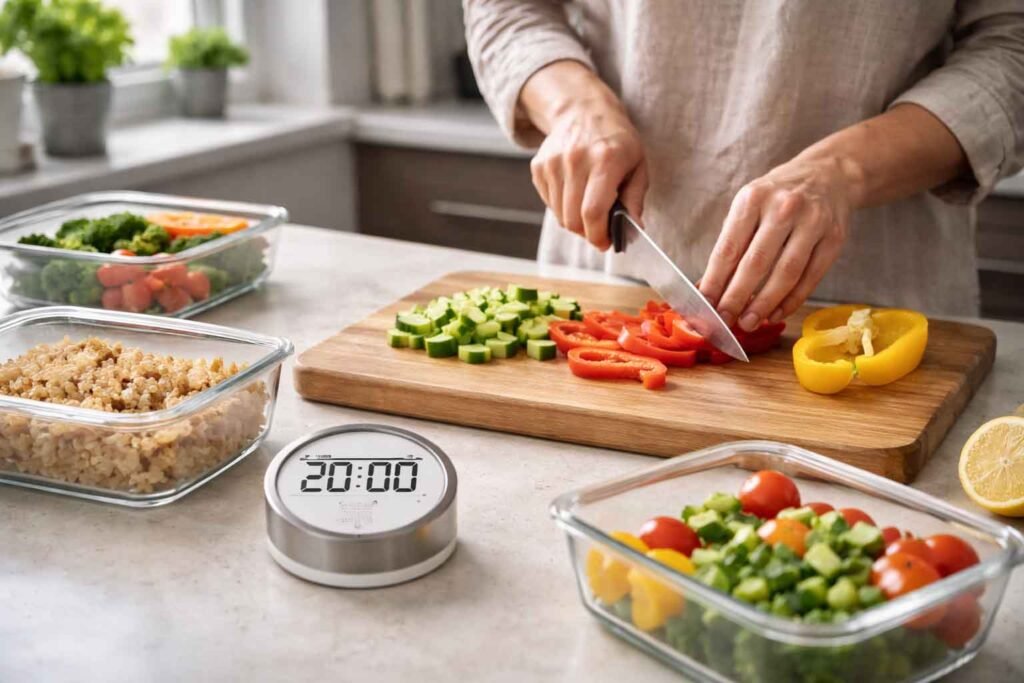
The 20-Minute Routine — Minute-by-Minute (HowTo-style)
This is the exact routine I use on a normal weeknight. It’s not a “Sunday reset.” It’s a manageable 20-minute cooking routine that works even when you’re tired.
Before you start: the 60-second plan
Pick 1 protein, 1 veg, 1 carb base, and 1 sauce. Then assign them mentally to two meals plus one backup. The backup is the difference between “I meal prepped” and “I still ordered dinner.”
Minute 0–5 — chopped veggie prep
My fastest method (knife + board + bowl)
I do all my chopped veggie prep first because it sets the pace. I chop one vegetable for cooking (like bell pepper or zucchini) and one “raw” vegetable for crunch (like cucumber or carrots). Everything goes into one bowl so the counter stays clear.
Shortcut options
- Use frozen veg when you need speed.
- Buy pre-cut mixes when it makes sense; you’re paying for convenience, and that’s okay if it keeps you consistent.
Minute 5–12 — Heat one main component (protein)
Skillet path (fast)
This is when my Cast iron skillet shines. A quick sauté or sear supports easy stir-fry at home and other one-pan dinner ideas without extra dishes.
One pan meals with minimal cleanup tips
- Start with a hot pan and a little oil so food doesn’t stick.
- Cook protein first, remove it, then cook vegetables in the same pan.
- Deglaze with a splash of water or broth; it lifts the browned bits and turns them into flavor.
Appliance path (hands-off)
On weeks when I want my hands free, I use the Air fryer for chicken or tofu, or I use the Instant Pot for shredded chicken, the Ninja Foodi for a fast pressure-cook-and-crisp combo, or a Crock-Pot when I want dinner to cook while I work. The point is to pick one tool that fits your week.
Minute 12–18 — Carb base + assembly line
pre-cooked grains planning
This is where a Rice cooker makes life easy. If you’re deciding on the best grains to cook once and use all week, I rotate rice and quinoa because both reheat well and fit into bowls, stir-fries, and soups. I’ll cook rice once and use it in bowls, stir-fries, and quick soups.
If I’m cooking quinoa, I do it here too. And if I’m running on fumes, I keep Microwave rice cups as a perfectly acceptable shortcut my goal is consistency, not bragging rights.
Minute 18–20 — Portion + label + reset
No scale needed portioning
If you’ve wondered how to portion meals without a scale, here’s what works for me: I portion by container and hunger level. I aim for a protein portion about the size of my palm, vegetables filling at least half the container, and enough carb to feel satisfied. I adjust up or down depending on activity that week.
Container strategy
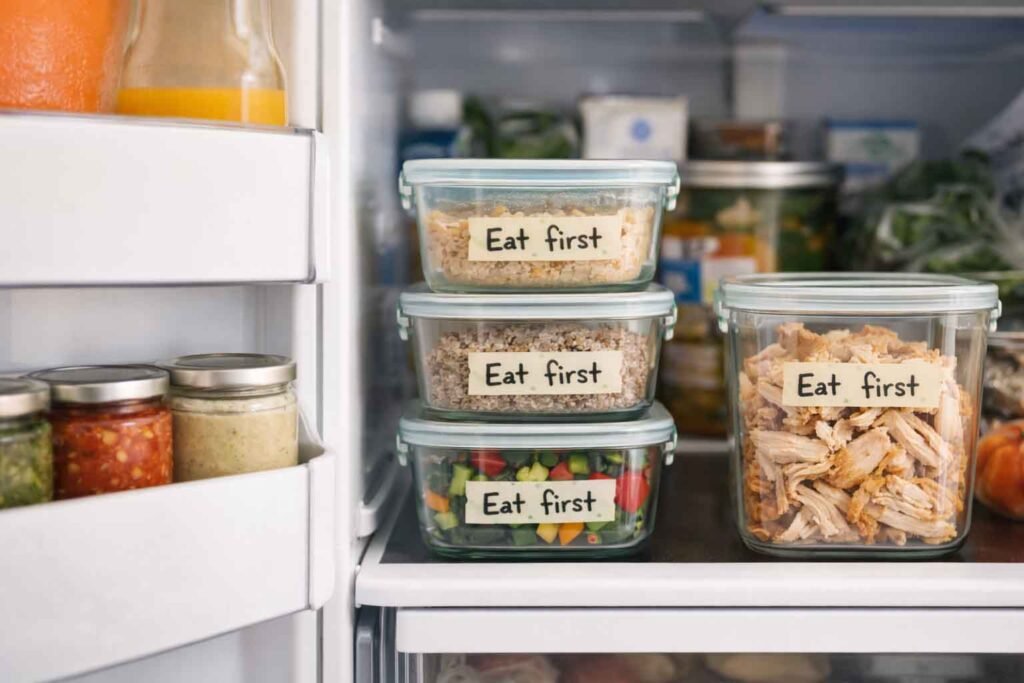
I label two containers “eat first” and stack them in the front row. That visibility trick matters more than it should.
The 2-minute sink + wipe habit (keeps it sustainable)
I immediately rinse the pan, wipe the counter, and set the containers in the fridge. This tiny reset is the backbone of a repeatable system.
Flavor Without Extra Work — Sauces, Seasonings, and Swaps
The fastest way to quit meal prep is to make food that tastes like “health food.” I learned to treat flavor as a requirement, not an add-on.
My “two sauces change everything” rule
I keep two sauces on hand each week one bright, one creamy. That gives me instant flavor boosts and sauces without extra cooking. My most-used options:
- Salsa (bright, fast, works with eggs or chicken)
- Pesto (rich, instantly changes grain bowls)
- Hummus (creamy, works as a sauce or snack)
Seasoning shortcuts that make repeats taste new
A small set of seasoning blends for quick meals makes repeating ingredients feel intentional. One of my favorites is Everything bagel seasoning because it upgrades eggs, cottage cheese, and avocado toast in seconds. I also rotate simple profiles:
- Tex-Mex (cumin, chili powder)
- Mediterranean (garlic, oregano)
- Classic American (paprika, black pepper)
- Lemon-herb (lemon pepper, dill)
quick sauce ideas to change flavors
When I’m bored, I don’t change the protein I change the sauce: salsa today, pesto tomorrow, hummus the next day. That’s the easiest variety strategy I’ve found.
Build Meals Fast — Mix, Match, and Rotate
This is where the system becomes “real life.” You’re not eating the same container for five days. You’re turning components into different formats.
My “3 buckets” that prevent boredom
I organize meals into three buckets:
- Bowls (hot or cold)
- Wraps/sandwiches
- Salads/snack plates
This simple structure is my meal rotation system. It’s also why this method feels like food you’d choose, not food you’re stuck with.
Bowls and hot meals
ready-to-assemble bowls (examples)
- quinoa + Chickpeas + roasted vegetables + Pesto
- Brown rice + rotisserie chicken + Salsa + a handful of Bagged salad kits for crunch
These ready-to-assemble bowls are my go-to for quick lunches.
Fast dinner patterns
When someone asks me for quick dinners for one person, I don’t hand them recipes I give patterns. A bowl, a stir-fry, or a sheet-pan meal can all become quick low-effort dinners if you already have components.
It also makes it easy to build low effort high protein meals using simple protein options for fast meals like eggs, rotisserie chicken, or canned fish.
Salads that stay crisp
mason jar salads
I started making mason jar salads after too many sad, soggy salads. The trick is layering: dressing on the bottom, then sturdy vegetables, then protein, then greens on top. That’s how you get make-ahead salads that don’t get soggy.
Breakfast and snacks that feel like “meals”
grab-and-go breakfast ideas
My most reliable grab-and-go breakfast ideas are simple: yogurt bowls, egg muffins, or cottage cheese with fruit and seasoning. If you’re searching for easy breakfast meal ideas for busy mornings, these are the options that don’t require morning motivation.
healthy snack boxes
I also prep healthy snack boxes with cheese, fruit, carrots, hummus, and nuts. They’re basically snack boxes for adults healthy enough to count as lunch on a busy day.
Storage, Reheating, and Food Safety
I used to treat storage like an afterthought. Then I got sick once from questionable leftovers and decided food safety deserved a spot in the system. I follow general guidance from the USDA Food Safety and Inspection Service (FSIS) and keep my rules simple and consistent.
How I store components to avoid waste
My fridge used to be a black hole. Now I follow refrigerator organization for meals with three rules:
- Clear containers so I can see food.
- “Eat first” row at eye level.
- Sauces and toppings in the door so I actually use them.
Reheating that doesn’t taste sad
Good reheating best practices matter. My microwave rule: add a splash of water to rice, cover loosely, and heat in short bursts to avoid rubbery texture. My skillet rule: reheat proteins quickly over medium heat and add sauce at the end so it doesn’t burn.
how to store cooked rice safely
I cool rice quickly, store it in a shallow container, and refrigerate it promptly. When reheating, I make sure it’s steaming hot. I don’t leave cooked rice sitting out “for later” because that’s where problems start.
how long cooked chicken lasts in the fridge
In my kitchen, cooked chicken is an “eat within a few days” item. If I know I won’t use it soon, I freeze it in a single portion. This reduces waste and keeps me from gambling on leftovers.
A Week of Examples — Your Flexible Plan (Not a Rigid Menu)
If you’ve ever asked, how to meal plan when you live alone, the hidden challenge is that plans fall apart the moment life happens. So I plan for flexibility, not perfection.
My “semi-structured” approach
I pick 2 proteins, 2 vegetables, 2 carbs, and 2 sauces. That’s enough variety without overbuying. It also keeps shopping fast because you’re not reinventing the wheel every week.
Sample 20 minute cooking schedule for the week
Here’s a realistic 20 minute cooking schedule for the week that I actually use:
- Day 1: 20-minute prep (protein + veg + grains)
- Day 3: 5-minute refresh (chop one fresh veg, restock sauce)
- Day 5: 5-minute refresh (make a jar salad or snack box)
The “backup meal” is always present usually a microwave rice cup plus canned fish or eggs.
Suggested rotation
To keep boredom low and waste lower, I rotate formats: bowls, stir-fry, salads, then wraps. This is what weekly meal rotation ideas for one looks like in real life: the ingredients repeat, the experience doesn’t.
Make it picky-eater friendly
If you’re dealing with meal prep for picky eaters living alone, the trick is to keep components separate: sauce on the side, vegetables cooked simply, and mix at the moment you eat. It’s easier to customize without doubling your work.
Budget + No-Waste Tactics I Wish I Used Earlier
The biggest reason solo meal prep gets expensive is “aspirational shopping.” I used to buy specialty ingredients for one recipe, then watch them expire.
My top no-waste cooking strategies
These are the tactics that made the biggest difference for me:
- Freeze leftovers in singles immediately.
- Buy sturdy produce (or use frozen).
- Plan two overlap meals per protein.
- Keep two sauces to rescue bland meals.
This is where freezer-friendly single portions become a habit, not a project.
Freezer strategy for busy weeks
When my week looks unpredictable, I lean into freezer meals in single servings. I freeze cooked chicken, cooked grains, and even portions of beans. It’s not glamorous, but it saves me on the nights when cooking feels impossible.
Leftovers that feel intentional
I use leftovers as inputs: chicken becomes tacos, salads, or bowls; rice becomes stir-fry. This mindset keeps leftovers from turning into forgotten containers, and it makes smart leftovers planning feel natural.
“If You Only Have 10 Minutes” — The Emergency Versions
Some days you don’t have 20 minutes. That’s not failure that’s life.
Microwave lunch build (work-from-home friendly)
My fastest path to microwave-friendly lunches is simple: microwave rice cup + frozen vegetables + canned tuna or salmon pouch + sauce. It’s the answer to easy microwave lunch ideas at home that still feels like a real meal.
Pantry-only meal fallback
On pantry-only days, I rely on beans, rice, and sauces. These pantry staple meal ideas keep me fed without another store run.
Recipe-Starters (Not Full Recipes) That Cover Multiple Meals
These are “modules,” not strict recipes. Each one is designed to become multiple meals with minimal extra effort.
Rotisserie chicken module
If you want fast meal ideas with rotisserie chicken, here’s my approach: shred it, portion it, and decide its “role.” Half becomes bowls, half becomes wraps or salads. Add salsa for Tex-Mex nights or pesto for Italian vibes. This is my most consistent way to build rotisserie chicken meal ideas without getting bored.
Tuna/salmon module
For tuna and salmon pouch meal ideas, I mix canned fish with a spoon of plain yogurt (or hummus) plus seasoning. It becomes a sandwich filling, a salad topper, or a bowl protein. This is the pantry version of canned fish meal ideas that doesn’t taste like “emergency food.”
Vegetarian module
For quick vegetarian meals for one, I combine chickpeas or black beans with quinoa or brown rice, add vegetables, and finish with pesto or hummus. It’s satisfying, cheap, and easy to adjust.
One-pan stir-fry module
This is my default easy stir-fry at home: cook protein in a hot skillet, add frozen vegetables, then add sauce at the end. It’s one of the simplest one-pan dinner ideas that still feels fresh.
Common Problems and Fixes (What failed for me)
I want to be honest: I didn’t “nail” this on the first try. These are the problems I hit and the fixes that made it stick.
“I prepped and still ordered takeout”
My fix: I started treating sauces as mandatory and kept a visible backup meal. When food tastes good and feels easy, it gets eaten.
“My produce dies too fast”
My fix: more frozen vegetables, fewer delicate greens, and jar salads. I also bought smaller quantities even if the unit price was higher.
“It tastes repetitive”
My fix: rotate sauces, rotate seasonings, rotate formats. I kept ingredients simple and variety came from assembly.
“Containers take over my fridge”
My fix: fewer containers, better stacking, and only prepping 3–5 meals max. The goal is a system you repeat, not a fridge you can’t close.
Topical Authority Add-Ons (Internal Linking Cluster Ideas)
If you’re building out a nutrition or lifestyle site, these are supporting posts that naturally expand authority without duplicating this guide:
- Beginner guide to single-serving batch cooking
- How to build a weekly meal plan in 5 minutes
- Best sheet pan cooking basics for small kitchens
- Complete guide to meal component prep
- Best vegetables to prep ahead list (with storage times)
- How to create small-batch cooking ideas when shopping at U.S. stores
FAQs (10 total)
1) What’s the simplest simple meal formula for balanced eating when cooking for one?
The simplest simple meal formula for balanced eating is the same one I use: a protein you enjoy, a vegetable you’ll actually eat, and a carb that makes you feel satisfied. I keep it practical by using the MyPlate idea as a loose guide half the plate produce when possible, plus protein and a carb.
The moment I stopped aiming for perfection and started aiming for repeatable patterns, my meals got healthier and easier at the same time.
2) What are the best meal prep containers for single portions in the U.S.?
The best meal prep containers for single portions are the ones you’ll use consistently. I prefer glass because it doesn’t stain and it reheats well; plastic is lighter for commuting. Look for containers that stack neatly and have leak-resistant lids. In my routine, I keep a small set so I don’t over-prep. If containers are annoying to wash or store, meal prep becomes a chore instead of a help.
3) What are the healthiest lunch ideas for one that still reheat well?
My favorite healthy lunch ideas for one that reheat well are bowls and stir-fries: a grain base (quinoa or brown rice), a protein (chicken, eggs, beans, or fish), and vegetables. Add sauce after reheating so it stays fresh.
Another option is a jar salad with protein on top and dressing on the bottom no soggy greens, and you can eat it cold.
4) What are the beginner-friendly batch cooking steps if I hate cooking?
The most beginner-friendly batch cooking steps are: cook one protein, prep one vegetable, and choose one carb base. Stop there. Add one sauce so it tastes good. That’s enough to get multiple meals without turning cooking into a marathon.
I also recommend keeping one “backup” microwave meal so you don’t feel like you failed when the day gets busy.
5) What are the easiest vegetables to prep ahead without them getting soggy?
The easiest vegetables to prep ahead are the sturdier ones: carrots, cucumbers, bell peppers, broccoli, and cabbage. They hold up for days. frozen vegetables are also excellent because they’re prepped and don’t spoil.
If greens are your struggle, store them with a paper towel and keep dressing separate. That one tweak is the difference between “I’ll eat a salad” and “I threw out a salad.”
6) How do I plan one-pan meals with minimal cleanup in a tiny kitchen?
To plan one-pan meals with minimal cleanup, cook in this order: protein first, remove it, then vegetables, then combine with sauce at the end.
Use parchment on sheet pans, and clean as you go in small moments (a quick rinse while something heats). In my experience, the biggest barrier isn’t cooking it’s the idea of a sink full of dishes afterward. Designing for cleanup makes the routine repeatable.
7) How can I keep meals high-protein without getting bored?
To keep meals high-protein without boredom, rely on flexible proteins (eggs, chicken, beans, fish) and change the flavor profile with sauces and seasonings.
I also rotate formats: bowl today, wrap tomorrow, salad the next day. This supports high-protein meal ideas without forcing you into the same meal every day. The protein can repeat; the experience shouldn’t.
8) How do I prevent food waste when shopping and cooking solo?
If you’re wondering how to avoid food waste cooking for one, my best tip is the overlap rule: don’t buy an ingredient unless it can appear in at least two meals.
Add frozen veg to protect your budget and keep a pantry protein like tuna or beans. I also label containers “eat first” so nothing gets lost in the back of the fridge.
9) What’s the best way to set up a realistic weekly routine if my schedule changes daily?
A realistic routine is one anchor session plus tiny refreshes. I do one 20-minute prep, then two 5-minute refreshes to chop one fresh vegetable or assemble a salad. That’s enough structure without rigidity.
If the week gets chaotic, the backup microwave meal prevents a spiral into expensive takeout. The goal is stability, not a perfect calendar.
10) How can I turn leftovers into lunches that don’t feel like leftovers?
The trick is to change the format and add one fresh element. Turn chicken into a wrap with crunchy veggies and hummus, or turn rice into a quick stir-fry with frozen vegetables and salsa. This keeps portion-controlled leftovers from tasting stale.
I also keep a “topping shelf” in the fridge sauces, seasoning, and crunchy add-ons so leftovers get a quick upgrade.
Conclusion — Your Next 7 Days
If you’ve tried meal prep and hated it, I want you to try it smaller not harder. Pick one protein, one vegetable, one carb base, and one sauce today.
Do one 20-minute session and set up two backup meals you can heat in minutes. That’s enough to feel the difference this week.
If I were starting again, I’d focus less on variety and more on repeatability. The system works because it’s simple: small batches, flexible components, and flavors you actually enjoy.
Once that foundation is in place, everything else health goals, budget goals, and time goals gets easier to hit.
Author Bio
Author: Charlotte Noah writes practical, real-life food systems for busy solo eaters, focused on simple routines, smart storage, and minimal waste.
Published by: Ahmed Saeed.