





Disclaimer: This article is for general information and civic education only. It is not legal advice, not professional journalism guidance, and readers should always consult original documents and qualified experts when making decisions.
Government alerts hit phones all day long: breaking news banners, emergency updates, big policy rollouts. Behind many of those alerts is a simple, often overlooked document.
Anyone who wants to understand U.S. public life eventually has to learn how to read a press release instead of only trusting the headline that sits on top of it.
This guide walks through exactly how an informed reader can analyze government press release material, slow down the noise, and see what’s really being said.
It’s grounded in years of observing how agencies push out information, how journalists respond, and how ordinary people can turn that into a practical citizen guide to government information.
The goal is not to turn readers into cynics. Instead, this is a nonpartisan guide to official press that respects facts, encourages transparency and accountability, and helps people recognize when the message is being massaged for political advantage.
Along the way, the article shows how to spot cherry-picked data, loaded language, and emotional appeals, and how to lean on evidence-based claims and independent verification to get closer to the truth.
Because this topic is especially hot in the United States right now, with trust in institutions under pressure, the article also focuses on source credibility, long-term policy impact, and practical habits that anyone can apply even without a background in law, statistics, or journalism.
How to Read a Press Release: Quick Overview for U.S. Citizens
Before diving into details, it helps to see a simple step by step press release analysis that readers can reuse every time an agency or official drops something new.
- Check who is speaking. Is it the White House Press Office, an agency, a court, or a local office? That alone tells a lot about priorities, legal power, and level of detail.
- Look at timing. Ask whether elections, a court decision by the Supreme Court of the United States, or a crisis might explain the timing. This is the beginning of understanding timelines in policy news.
- Scan the lead. The first paragraph usually contains the core claim and the main talking points. Note them before getting pulled into the narrative.
- Highlight concrete facts vs. vague language. That’s the foundation of distinguishing data from opinion in releases.
- Check links and citations. Look for primary source documents, not just summaries.
- Compare with outside coverage. Later, compare press release to independent news from neutral outlets.
- Write down follow-up questions. Use them as a personal checklist of questions to ask about press releases for future reading.
When a careful reader follows these steps, it becomes much easier to begin separating facts from spin in politics, spotting gaps, and deciding what deserves more attention and what is just noise.
Quick Checklist for Busy Readers
Someone in a hurry can use a fast “seven-W” checklist that still respects source credibility:
- Who issued the document (agency, office, or elected body)?
- What specific action, rule, or funding decision is being announced?
- When does it take effect, and how does that fit into understanding timelines in policy news?
- Where does the change apply—nationwide, in one state, or in a specific community?
- Why now? Could there be a political calendar, scandal, or crisis behind the timing?
- Which people or groups benefit or lose out, in terms of policy impact?
- **What might be a hidden conflict of interest for the speaker or agency?
Treat this as a reusable “pocket tool” that supports personal media literacy for political news whenever new official announcements appear.
Understanding Government Press Releases and Official Announcements
What Is a Government Press Release?
At its core, a government press release is an official announcement from a public body, written to be quoted. It’s a prepared document that explains decisions, programs, investigations, or emergencies in a way that steers the narrative from the very first line.
Good interpreting official announcements starts with remembering who the intended audience is. These texts are written first for journalists and staffers who need quick facts under deadline, and only secondarily for ordinary citizens. That’s why they often sound clipped, formal, and full of jargon.
The underlying goals are fairly consistent: shape how a story is told, manage framing, and set up friendly headlines before critics and opponents can speak. This is exactly where media literacy for political news becomes essential: a reader is allowed to appreciate the information and still ask, “Why is it worded this way?”
Understanding Federal News Releases vs. Local Announcements
Understanding federal news releases means recognizing that national stakes are often large—foreign policy, nationwide health policy, or major regulatory changes. These tend to come from cabinet departments or the Executive Office and may quickly involve U.S. Congress, the House of Representatives, or the United States Senate.
By contrast, a state governor’s office, a city mayor’s office, or a local public information officer announces more localized decisions: curfews, school policies, city ordinances, or localized disaster responses. The structure may be similar, but the legal power and budget behind them differ.
Savvy readers compare federal and state announcements on the same issue. Differences in what is emphasized can hint at quiet disagreements, cautious editorializing, or competing priorities that only show up in fine print.
Who Actually Writes and Publishes These Documents?
Behind almost every release is a specialized communications shop. At the national level, the White House Press Office is a central hub, and the Press Secretary becomes the public face of that operation.
Across the federal government, agencies like the U.S. Department of State, the U.S. Department of Justice, the U.S. Department of Health and Human Services, the Centers for Disease Control and Prevention, the Federal Emergency Management Agency, and the Environmental Protection Agency all maintain their own public affairs or communications teams. These are classic agency press offices that manage statements, blogs, and social media feeds. Learning understanding agency press offices helps the reader judge tone and recognize institutional habits over time.
Oversight and budget entities also issue releases that are often more technical but extremely important: the Congressional Budget Office, the Office of Management and Budget, and the Government Accountability Office.
Regulatory and data-focused bodies such as the Federal Communications Commission and the U.S. Census Bureau publish updates that are heavy on numbers but vital for understanding how rules and spending work. All of these affect source credibility in their own policy domains.
Where to Find Reliable Government Information Online
A lot of the most important material never becomes a viral headline. It lives in quieter but more authoritative venues.
The Federal Register and the Code of Federal Regulations are primary sources for rules, definitions, and procedures. They are an excellent plain language guide to federal updates once a reader knows where to look.
For deeper transparency, the Freedom of Information Act allows individuals to request internal records and emails. That’s where journalists and advocates often find original documents behind news, building stories closer to the primary source instead of relying only on talking points.
Because check sources in government announcements is so critical, experienced readers also compare agency materials with secondary reporting from outlets like the Associated Press, Reuters, and NPR.
This combination original documents plus neutral coverage makes it easier to evaluate credibility of government news without falling into all-or-nothing trust.
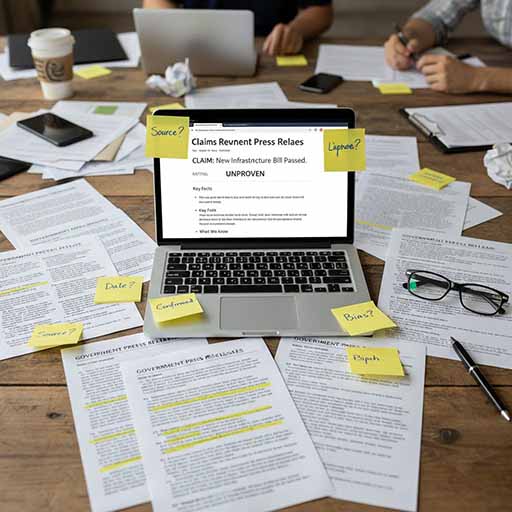
Step-by-Step Press Release Analysis Framework
Step 1: Start with the Basics — Source, Date, and Context
Strong critical reading of official statements doesn’t start with emotions; it starts with a calm note of “who, what, when, where, why.” That means identifying the issuing office, recognizing whether it’s a new initiative or a follow-up, and checking the date carefully.
Timing often reveals more than the adjectives. Major announcements tend to cluster around elections, high-profile hearings in U.S. Congress, decisions at the Supreme Court of the United States, or disasters that demand a response. These connections are valuable contextual clues and part of understanding timelines in policy news.
Sometimes, a release is labeled under a press embargo, meaning journalists see it early but agree not to publish until a certain hour. Even though the public rarely sees the embargo notice, remembering that this system exists explains why many outlets post the same story at the same time.
Step 2: Analyze Government Press Release Structure Like a Pro
Once the basics are clear, it becomes easier to analyze government press release structure. Most follow a template: headline, subhead, dateline, lead paragraph, body with quotes and details, and a closing boilerplate.
The headline usually showcases the preferred official narrative, using framing that encourages certain emotional responses. The lead paragraph distills the most important talking points and spells out the headline claim plus one or two specifics about policy impact.
Readers trained in decoding political talking points see patterns: phrases that recur across multiple speeches, repetition of the same benefit, and careful avoidance of words that might trigger backlash. Noticing those choices turns a flat document into a more transparent one.
Step 3: Distinguish Data from Opinion in Releases
A crucial skill is to distinguish data from opinion in releases line by line. Government authors often blend statistics, forecasts, and promises into a single smooth paragraph.
Basic statistical literacy helps here. When a release cites percentages, trend lines, or rankings, readers can ask: “What is the baseline? Over how many years? Compared to what?” This is the heart of learning to evaluate statistics in official reports.
Red flags include one-sided numbers—classic cherry-picked data—or the absence of any numbers where one would naturally expect them. These gaps can lead to selective omission, which is not lying but still distorts reality.
Step 4: Reading Between the Lines in Briefings
Press releases rarely exist alone. They are often backed by press briefings or conference calls where officials field questions. Effective reading between the lines in briefings means paying attention not only to what is said, but what is dodged.
Markers of trouble include vague metaphors, heavy reliance on optimistic adjectives, and repeated loaded language that paints opponents as reckless or dangerous. Strong emotional appeals are natural in times of crisis, but in calmer situations they may be covering for weak evidence or uncertainty.
Quiet shifts in wording are another form of editorializing—moving away from neutral description into argument. When a reader spots these changes, it becomes easier to separate genuine urgency from political theater.
Step 5: Questions to Ask About Press Releases
There is no substitute for curiosity. A list of questions to ask about press releases helps turn that curiosity into a structured fact-checking process. For example:
- What problem does this claim to solve, and how was that problem measured?
- Is there a clear explanation of costs and trade-offs?
- How will success be evaluated a year from now?
- Are there any obvious conflict of interest issues for the agency or officials mentioned?
- Which affected communities are quoted—and which are not?
Writing questions down builds a personal citizen guide to government information and gives structure to later research.
Step 6: Cross Checking Government Claims
A press release is only the first word, not the last. That is why cross checking government claims is so important before fully trusting or dismissing them.
Strong readers verify claims in public statements by seeking corroborating evidence in budget documents, court filings, or audits. They also check sources in government announcements by following hyperlinks to underlying memoranda or technical reports.
Independent organizations help, too. Sites like FactCheck.org, PolitiFact, and research groups such as the Pew Research Center are built around testing claims and documenting context. Their work, combined with official records, strengthens independent verification and reduces the risk that a single release drives all understanding.
Step 7: Evaluating Credibility and Red Flags
Over time, readers naturally begin to evaluate credibility of government news by patterns rather than one-off stories. Do certain offices issue timely corrections? Do they provide detailed data tables? Or do they blame others and never admit error?
Warning signs include spotting red flags in official messaging such as overuse of slogans, dramatic language unsupported by facts, and a track record of misstatements. Techniques like quote mining (pulling a single line out of context) and selective omission (strategically leaving out key information) are subtle forms of spin.
Recognizing these tactics is closely related to spotting propaganda in official news. The goal, however, is not to label everything as propaganda, but to keep enough distance to hold officials to standards of transparency and accountability.
Separating Facts from Spin in Politics and Policy
Spin, Framing, and the Official Narrative
In public communication, spin is best understood as the art of making a fact look better or worse without changing the fact itself.
Government communicators rely heavily on framing choosing context and comparisons and on building a strong official narrative that repeats across speeches, interviews, and documents.
Those messages are carried by talking points, often refined by senior staff and stress-tested in internal meetings or polling.
Readers who become comfortable decoding political talking points start seeing how often the same phrase appears, even in unrelated situations.
Understanding this pattern makes it easier to evaluate media literacy for political news in general, because once a narrative is visible, it has less power to manipulate.
Identifying Bias in Government Communication
Every institution has priorities. Learning to identify bias in government communication means noticing which stakeholders are consistently centered and which are minimized or ignored.
Sometimes bias is openly partisan bias, where one political party’s views receive more favorable treatment. Other times it is institutional such as emphasizing national security over civil liberties, or economic growth over environmental protection.
The key is to separate factual material from editorializing. A release can describe a new law accurately and still push a specific interpretation. Recognizing that distinction helps citizens argue about policy honestly, rather than fighting over distorted versions of reality.
Spotting Propaganda and Red Flags in Official News
When spotting propaganda in official news, readers look for a cluster of warning signs: intense moral language, blanket praise for allies, sweeping condemnation of opponents, and absence of nuance.
This often appears as repeated emotional appeals without new information, or statistics presented without sources. Within such content, there may still be evidence-based claims, but they are packaged in a way that resists scrutiny.
Connecting these patterns back to spotting red flags in official messaging encourages citizens to keep calm, seek out more data, and resist share-first, think-later habits—especially on social media.
Fact-Checking Government Statements Like a Pro
How to Fact Check Government Statements Systematically
A disciplined reader can build habits that mirror what good newsrooms do. Learning how to fact check government statements starts with a consistent fact-checking process:
- Identify the core claim—usually a sentence about costs, benefits, or safety.
- Find any linked documents and download them for later review.
- Search for the same claim in agency reports, budget tables, or legal filings.
- Compare the wording with how neutral outlets describe the same situation.
- Note where independent verification is still missing.
This method transforms passive scrolling into active engagement with public life.
Fact Checking Political Press Statements and Talking Points
Fact checking political press statements on issues such as healthcare, crime, or defense spending often requires external data. Nonpartisan institutions like the Congressional Budget Office and the Government Accountability Office analyze cost estimates, implementation problems, and long-term implications.
Combining that research with surveys and long-range studies from the Pew Research Center allows readers to judge whether repeated talking points genuinely align with the evidence. When they don’t, that gap becomes part of the story.
Using Independent Journalism and Fact-Checking Sites
Independent journalism is a crucial counterweight to official messaging. Outlets such as the Associated Press, Reuters, and NPR strive to present balanced secondary reporting, often drawing from multiple agencies and expert voices.
These stories can be read alongside deeper dives from FactCheck.org and PolitiFact, which specialize in scrutinizing claims from elected officials and agencies. Meanwhile, unfiltered coverage from C-SPAN lets viewers watch hearings and briefings directly, comparing raw footage with the carefully worded release.
Comparing Official Messaging with Independent News
Compare Press Release to Independent News Stories
A practical habit is to compare press release to independent news side by side. First, read the release and mark what seems most important. Then, look at two or three neutral news articles on the same announcement.
This makes it easier to see which facts are emphasized, which are downplayed, and where journalists challenge certain claims or insert clarifying context. Often, reporters quote an on-the-record statement from the release and then add outside expert reactions.
Sometimes, additional context comes from off-the-record background conversations, where officials brief journalists but cannot be named. While the reader does not see those conversations directly, understanding that they exist helps explain why coverage sometimes goes beyond what was written.
How Journalists Cover Government Press in the U.S.
Understanding how journalists cover government press sheds light on why certain stories evolve after the first announcement. Reporters attend briefings, study supporting documents, and call affected communities, academics, and advocacy groups.
Their work is governed by norms around sourcing and attribution: who said what, when, and under which conditions. They also must respect any press embargo rules agreed with agencies, especially when dealing with market-sensitive or national security information.
Recognizing this process helps readers give credit to good reporting, while still checking whether questions about source credibility and policy impact have been fully addressed.
Reading Official Statements Side by Side
One practical exercise in personal step by step press release analysis is to print or save both the official document and at least one news article, then mark them with different colors.
Readers can underline where the article quotes the release directly, circle areas where it adds explanation, and highlight where it points out gaps. Differences in framing, emphasis, and structure reveal hidden assumptions and subtle editorializing that might otherwise go unnoticed.
Understanding Legal and Technical Language in Releases
Understanding Legal Language in Releases
Many readers feel intimidated by dense, legalistic passages. A good understanding legal language in releases doesn’t require a law degree, but it does require patience and a willingness to slow down.
Key definitions and procedures often appear in citations to the Federal Register or the Code of Federal Regulations.
These references can be visited online and used as a plain language guide to federal updates, especially when paired with summaries from advocacy groups or academic centers. Agencies like the Federal Communications Commission often publish both dense rule language and easier explainer pages.
As people become more comfortable, they discover that seemingly technical phrases often contain the real content—who can do what, under which conditions, and with which exemptions.
Breaking Down Policy Announcements
When breaking down policy announcements, it helps to treat every release as a small case study. For example, an environmental rule from the Environmental Protection Agency or a health initiative from the U.S. Department of Health and Human Services can be translated into ordinary language:
- Which behaviors are now required, allowed, or restricted?
- Who enforces those rules, and with what tools?
- How might this reshape day-to-day life for different groups?
By answering those questions, readers see policy impact as something grounded in real experiences, not just slogans.
Understanding Agency Press Offices and Boilerplate Language
Almost every release ends with boilerplate text about the agency’s mission and past achievements. Learning understanding agency press offices includes recognizing this section as institutional self-description, not neutral history.
Sometimes these paragraphs contain helpful links or statistics, but they can also blur the line between information and promotion.
Readers can decide when to treat the boilerplate as mere background, and when to test its claims as evidence-based claims that deserve scrutiny.
Working with Timelines, Statistics, and Policy Impact
Understanding Timelines in Policy News
Policy rarely changes overnight. Effective understanding timelines in policy news means tracking proposals from announcement to rulemaking, judicial review, and implementation.
For national policies, that often means following hearings in U.S. Congress, votes in both the House of Representatives and the United States Senate, rulings at the Supreme Court of the United States, and budget negotiations shaped by the Office of Management and Budget and the Congressional Budget Office.
Mapping these events helps readers see whether an announcement is a serious step or just symbolic communication.
Evaluate Statistics in Official Reports
Numbers wield power. Learning to evaluate statistics in official reports includes checking original data sources, such as tables from the U.S. Census Bureau or technical appendices buried in agency PDFs.
Readers can ask whether the sample size is large enough, whether changes are actually meaningful, and whether other indicators tell a different story.
This approach connects statistical literacy to democratic self-government by making it harder to impress people with flashy but misleading figures.
Find Original Documents Behind News
Serious citizens increasingly want to find original documents behind news, and technology makes that easier than ever. Agency websites often post rule texts, impact assessments, and comment summaries.
In cases where information is missing, formal requests under the Freedom of Information Act can bring internal memos and emails to light.
Combining those records with a personal fact-checking process deepens understanding and makes it less likely that quote mining or selective omission will go unnoticed.
Building Strong Media Literacy for Political News
Media Literacy for Political News 101
Basic media literacy for political news rests on three ideas: every source has limits, every story is partial, and every reader has biases. The goal is not to eliminate bias, but to recognize it in oneself and others.
A balanced approach avoids both blind trust in every statement and total rejection of all institutions. Instead, it values corroborating evidence, welcomes correction, and treats disagreement as normal.
Nonpartisan Guide to Official Press for U.S. Readers
This article positions itself as a nonpartisan guide to official press: the tools described here work no matter which party controls the White House Press Office, Congress, or state governments.
Emphasis is placed on source credibility, documentation, and clear attribution of quotes and statistics. Attention to potential conflict of interest is treated as a standard part of responsible reading, not as an attack on any particular group.
Evaluating Credibility of Government News Over Time
Trust is not built in a day. Learning to evaluate credibility of government news means watching institutions for patterns over months and years. Do they acknowledge mistakes? Do they release detailed data? Do their forecasts line up with actual outcomes later?
Longitudinal research from groups like the Pew Research Center provides a wider view of how public trust rises and falls in relation to real events. This helps readers interpret their own reactions in a broader historical context.
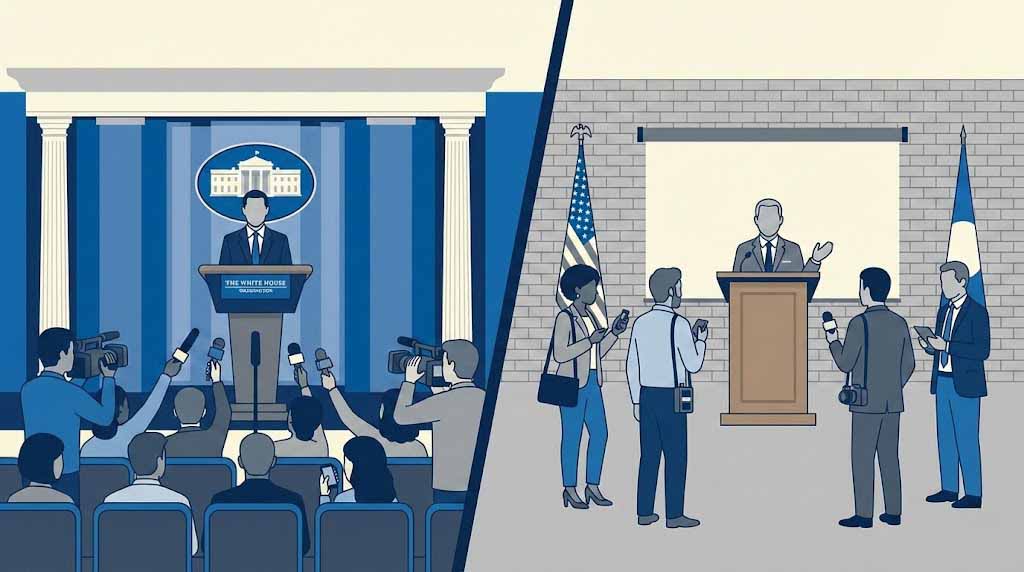
Real-World Examples: From White House Briefings to Local City Hall
How to Read White House Briefings and Press Gaggles
For national politics, many people start by watching televised updates or reading transcripts. Understanding how to read White House briefings includes knowing who is in the room and why.
The Press Secretary fronts daily briefings, sometimes joined by agency heads from places like the U.S. Department of State or the U.S. Department of Justice.
Viewers who combine live coverage on C-SPAN with the written transcript can watch for moments where answers shift, where talking points are repeated, and where reporters press on sensitive topics.
Comparing Federal and State Announcements
Crises such as hurricanes or wildfires offer clear case studies. The Federal Emergency Management Agency may issue one set of messages, while a state governor’s office and city mayor’s office publish their own updates through a local public information officer.
Those who compare federal and state announcements notice differences in tone, emphasis on responsibilities, and timing.
These variations serve as contextual clues about how different levels of government see their own roles and manage public expectations.
Contextualizing Quotes from Officials in the News Cycle
News stories often boil multi-page documents down to a handful of sentences. Learning contextualizing quotes from officials means going back to the full release or transcript and seeing what comes before and after a catchy line.
This protects readers from quote mining, where a sentence is lifted away from its surrounding explanation, and from selective omission, where key qualifiers are removed.
It’s also another form of reading between the lines in briefings, because it reveals which parts of an argument were deemed worthy of attention and which were quietly ignored.
My Experience: Why This Guide Is Trustworthy
This guide reflects patterns documented over many years of watching agencies, courts, and legislatures communicate with the public.
The author has spent that time explaining understanding federal news releases and local announcements to students, community groups, and nonprofit teams, often walking them through breaking down policy announcements step by step.
In workshops, the same questions come up: How can readers judge source credibility? Where can they find the missing documents? Why do different outlets describe the same event so differently? This article distills answers to those questions into one structured resource.
Commitment to Transparency, Accountability, and Nonpartisanship
Throughout the guide, commitment to transparency, accountability, and avoidance of overt partisan bias is central. When examples are used, they are described at a high level rather than focusing on personalities or specific parties.
Readers are encouraged to apply the same habits to this text that they apply to any official announcements: look up cited entities, test recommendations against real-world outcomes, and consult multiple sources. That integrity-first mindset is exactly what healthy democratic culture requires.
FAQ: Common Questions About Reading Government Press Releases in the U.S.
FAQ 1: Why do government press releases matter for ordinary Americans?
They shape how news is written, how debates in U.S. Congress are framed, and how local officials respond. A single announcement from the U.S. Department of Justice or U.S. Department of Health and Human Services can affect taxes, benefits, public safety, or access to services. Understanding these documents is part of everyday civic literacy, not just insider politics.
FAQ 2: How can someone tell if a press release is leaving out important information?
Clues include vague numbers, missing time frames, and a lack of links to primary source documents. Readers should watch for cherry-picked data, overconfident claims that don’t mention trade-offs, and patterns of selective omission in related statements. When something feels incomplete, it usually is.
FAQ 3: What are the best places to cross-check government statements in the United States?
Strong options include the Federal Register, the Code of Federal Regulations, and agency data portals. For outside confirmation, nonpartisan outlets like the Associated Press, Reuters, and NPR help, along with dedicated fact-checking organizations such as FactCheck.org, PolitiFact, and research institutions like the Pew Research Center. These are all useful for independent verification and gathering corroborating evidence.
FAQ 4: How can readers avoid confirmation bias when they read official announcements?
Confirmation bias is the tendency to seek information that confirms existing beliefs. To resist it, readers can deliberately consult sources that challenge their views, apply the same standards of proof to allies as to opponents, and focus on verifiable facts rather than identity or loyalty. Asking structured questions to ask about press releases helps keep emotions in check.
FAQ 5: What’s the difference between a press release and a news article?
A press release is a message from the institution itself, meant to be quoted directly. A news article adds secondary reporting, context, outside voices, and sometimes analysis. It also follows norms of attribution, clearly stating who said what and when. Recognizing that difference helps readers understand why a release may sound more polished and one-sided than a full article.
FAQ 6: How do journalists use on-the-record and off-the-record information?
Reporters rely on on-the-record statement quotes that can be attributed by name, as well as off-the-record background briefings that inform their understanding but cannot be directly cited. These practices apply whether the source is the White House Press Office, a state governor’s office, or a city mayor’s office. Knowing this helps explain why coverage sometimes includes insights that never appear in the official text.
FAQ 7: How can someone practice press release analysis at home?
A helpful routine is to pick one or two new releases per week and apply the full step by step press release analysis described in this article. Track talking points, note examples of loaded language, and compare each document with independent coverage. Over time, patterns stand out, and the skill of analyze government press release content becomes second nature.
FAQ 8: Are all government press releases trustworthy?
Many contain accurate information but are still shaped by institutional incentives and political goals. That is why tools like Freedom of Information Act requests, audits from the Government Accountability Office, and reports from the Congressional Budget Office are so valuable. They test claims against actual outcomes rather than marketing.
FAQ 9: How does video coverage like C-SPAN help people understand official statements?
Watching hearings and briefings on C-SPAN lets viewers see full exchanges rather than edited clips. Comparing that unfiltered footage with written releases or short news segments makes it easier to spot quote mining, editorializing, or spotting propaganda in official news that might otherwise slip past casually.
FAQ 10: What if someone doesn’t have a background in law or statistics—can they still read releases effectively?
Absolutely. Basic statistical literacy, a willingness to slow down for legal definitions, and a simple plain language guide to federal updates are enough to start. Over time, using this citizen guide to government information and asking pointed questions to ask about press releases builds a powerful personal toolkit for understanding public life.
Author bio
Author: Mark Venil is a U.S.-based civic education writer who explains government, media, and public policy in plain language for everyday readers. Published by Ahmed Saeed.